
ChatGPT as an AI Recruiter: A Practical Playbook with Copy-Paste Prompts
Yes, ChatGPT can work as an AI recruiting assistant for the drafting-heavy parts of hiring — job descriptions, resume screening notes, boolean search strings, outreach sequences, and interview questions. According to OpenAI, ChatGPT is a large language model that generates text from a prompt; it does not browse your applicant database or make hiring decisions on its own. Treat it as a fast first draft, not a replacement for recruiter judgment.
That distinction matters more than it sounds. Adoption has moved fast: SHRM found organizational AI use in HR nearly doubled in a single year, up from 26% to 43%, yet Mercer found only 14% of talent acquisition teams have fully integrated AI into their workflow. This guide closes that gap with prompts you can copy, paste, and adapt today — plus the guardrails a human recruiter needs to keep around every output.
What ChatGPT Can (and Can’t) Do as an AI Recruiter
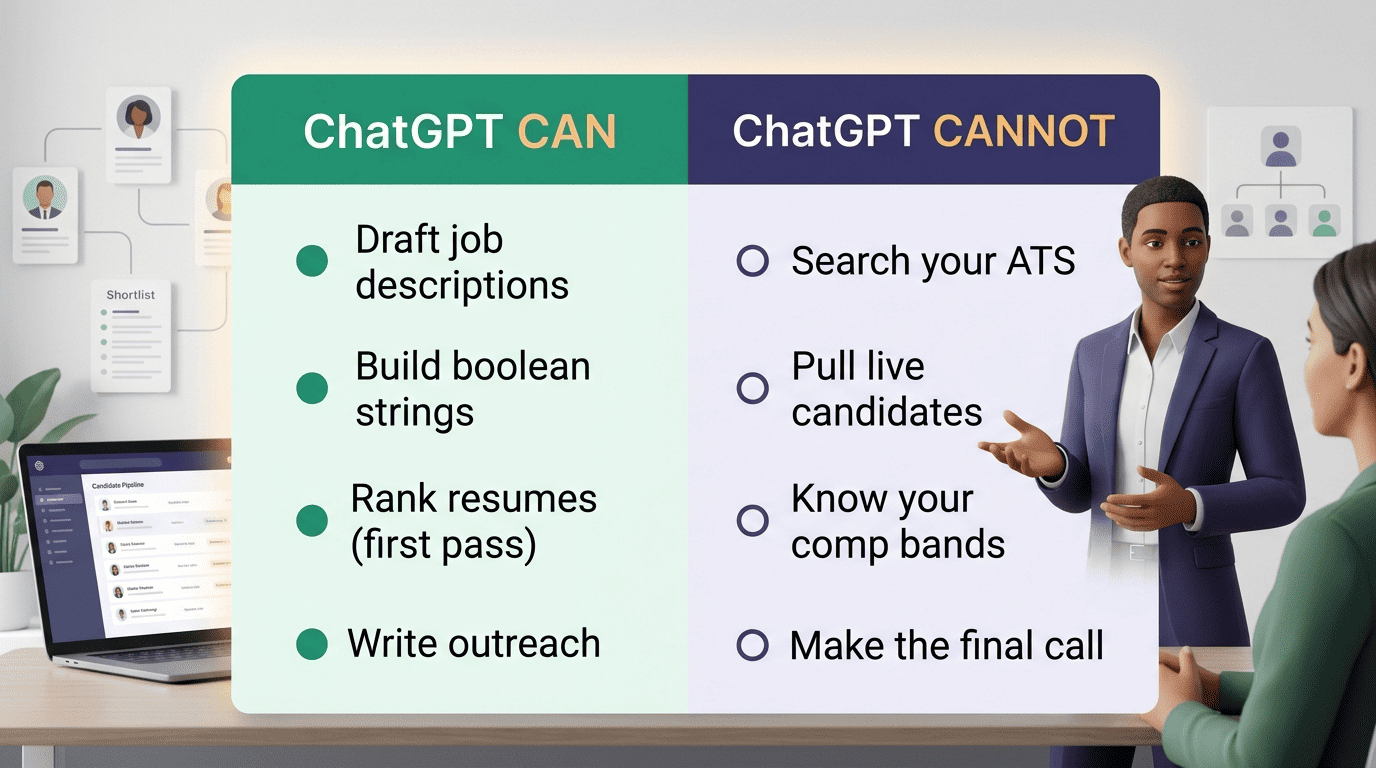
ChatGPT is a large language model (LLM) — a system trained to predict and generate text, described in more detail on Wikipedia’s Large language model page. That architecture explains both its strengths and its limits in recruiting. It drafts job descriptions, assists with resume screening, generates boolean search strings, writes outreach copy, and produces interview questions — all in seconds. What it cannot do is search a live database, pull real candidates from LinkedIn Recruiter, or query your ATS directly.
| Task | Can ChatGPT do it? | Notes |
|---|---|---|
| Draft a job description | Yes | Needs role, stack, level as input |
| Search LinkedIn/ATS for candidates | No | It writes the search string; you run it |
| Rank resumes against criteria | Yes, as a first pass | Human must verify every ranking |
| Remember your comp bands or policies | No | Provide them in the prompt each time |
| Make the final hiring decision | No | Always a human call |
| Generate boolean/X-ray strings | Yes | Test the string before using it |
Where it shines
Drafting at speed is the core value: job descriptions, outreach emails, boolean strings, interview questions, and candidate summaries all come back as a usable first draft in seconds instead of the 15-20 minutes a recruiter would spend starting from a blank page. Consistency is the second win — the same prompt template produces the same structure every time, which is exactly what a structured, defensible hiring process needs.
Where it fails
ChatGPT cannot access live candidate data or your ATS, and it can hallucinate — inventing details, statistics, or requirements that sound plausible but aren’t real. It doesn’t know your comp bands, your legal jurisdiction’s requirements, or your team’s culture, so it has no judgment on fit. Position it as a copilot for repeatable text, not a decision-maker, and every output above needs a human check before it goes anywhere near a candidate.
How to Write a Recruiting Prompt That Works
Vague prompts produce vague, generic output that takes longer to fix than to write from scratch. Spending an extra 30 seconds adding role, context, and constraints to a prompt routinely saves five minutes of editing garbage output later.
The Role + Context + Constraints formula
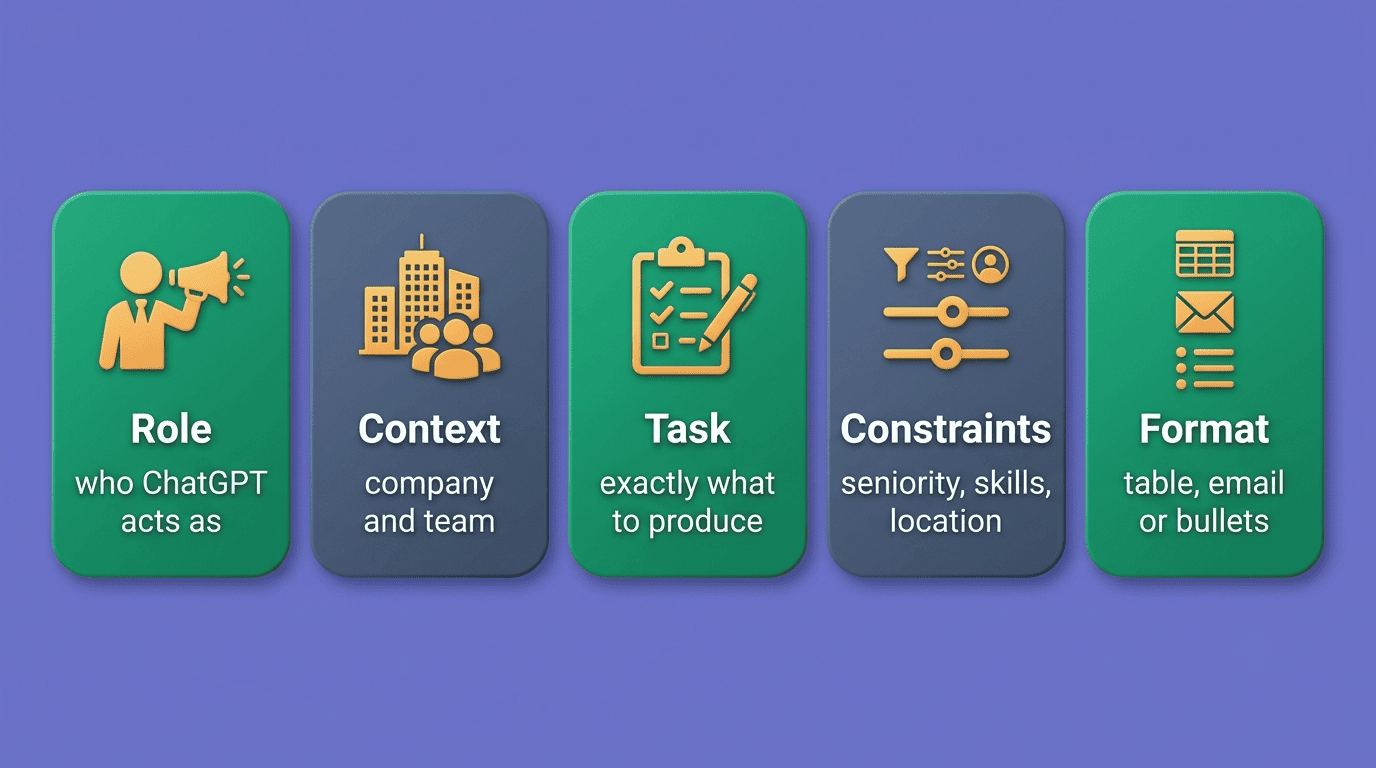
This is the core of prompt engineering for recruiting: give ChatGPT the same five pieces of information every time.
- Role — who ChatGPT should act as (e.g. “an expert technical sourcer”)
- Context — your company, the team, the hiring manager’s priorities
- Task — the exact thing you want produced
- Constraints — seniority, location, must-have skills, what to exclude
- Format — bullet list, table, email, three variants
A weak prompt looks like: “Write a job description for a developer.” A strong prompt looks like:
You are an experienced technical recruiter writing for a fast-growing SaaS company.
Write a job description for a [role] at [company], based in [location].
Required stack: [stack]. Seniority: [level] (X+ years).
Include: role summary, 5-6 responsibilities, 5-6 requirements split into
"must-have" and "nice-to-have", and a short "why join us" paragraph.
Keep it under 400 words and avoid gendered or exclusionary language.
The second version gives ChatGPT everything it needs to produce something close to final on the first try — no back-and-forth, no vague filler.
Prompt Pack 1 — Writing Job Descriptions
Job descriptions are the highest-leverage place to start, since every other stage of the funnel — sourcing, screening, interviewing — traces back to the requirements set here.
Generate a JD from scratch
You are an expert recruiter. Write a job description for [role] at [company],
a [industry] company based in [location]. Tech stack / tools: [stack].
Seniority level: [level]. Structure it as: role summary, key responsibilities
(5-6 bullets), requirements (must-have vs nice-to-have), and a closing
paragraph about the team culture. Keep language inclusive and avoid jargon
that could discourage qualified candidates from underrepresented groups.
Make an existing JD inclusive
Paste an existing posting and ask ChatGPT to clean it up:
Rewrite this job description to be more inclusive and gender-neutral.
Flag any exclusionary or "brogrammer" language (e.g. "ninja", "rockstar",
"must be a culture fit") and suggest neutral alternatives. Also flag any
requirement that could act as an unnecessary barrier for qualified
candidates (e.g. "10 years of experience" for an entry-level role).

[paste job description]
Read the flagged items carefully — some requirements are genuinely necessary, and only a recruiter with context on the role can tell the difference between a real must-have and an inflated one.
Prompt Pack 2 — Screening & Shortlisting Resumes
Resume screening is where ChatGPT saves the most hours, and where the privacy rule matters most. Before pasting anything, strip out:
- Full name and photo
- Email address and phone number
- Home address or precise location
- Any social media handles or personal links
Anonymize resumes first, or use OpenAI’s enterprise tools that come with data-handling agreements. For a deeper walkthrough of screening workflows, see this guide to AI recruiter resume screening.
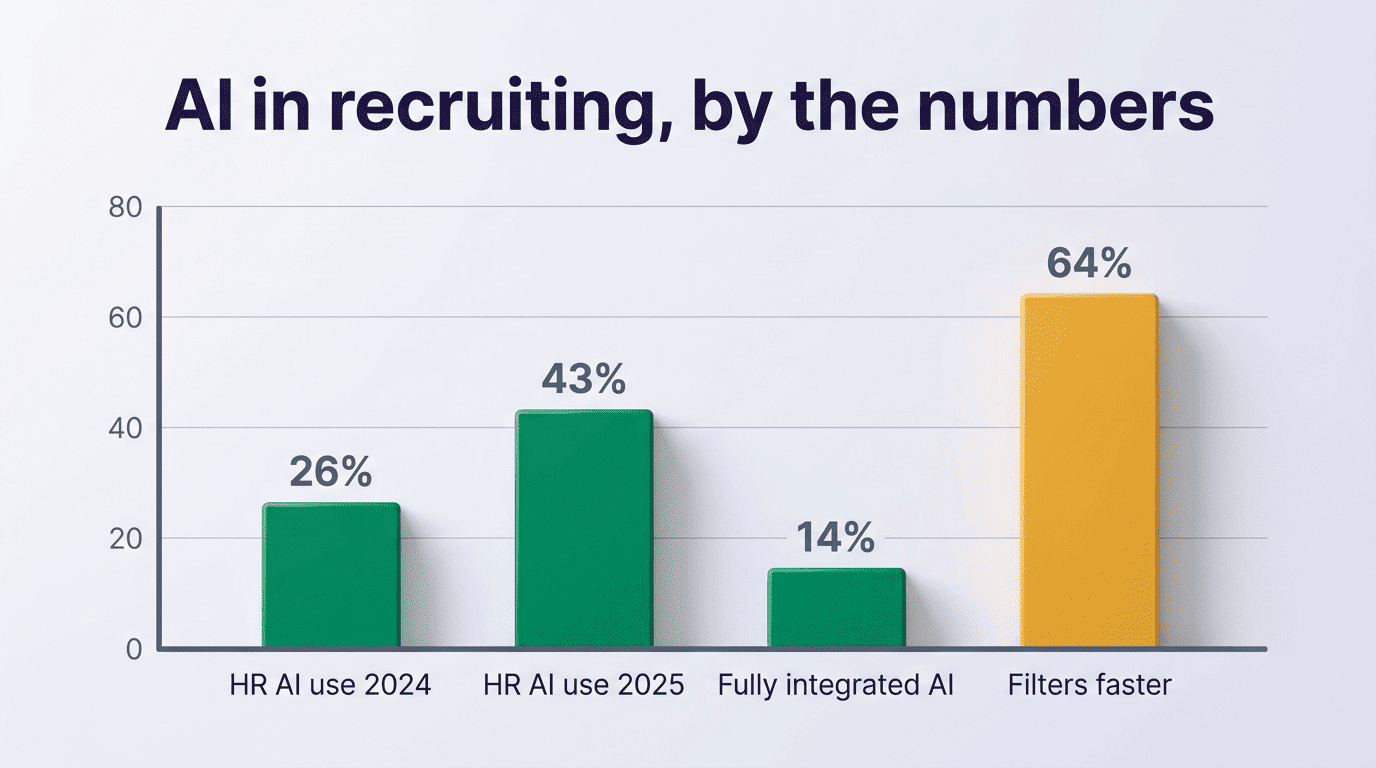
64% of HR professionals say AI tools help them filter out unqualified candidates faster, according to SHRM. Work in small batches — screening five resumes at a time against the same criteria keeps ChatGPT’s comparisons consistent and makes it easier for a recruiter to spot-check the reasoning.
Match a resume to the job description
Compare this anonymized resume against the job description below.
List pros and cons against each requirement, and give an overall
fit rating (Strong / Possible / Not a fit) with a one-sentence
justification. Do not infer age, gender, ethnicity, or any
protected characteristic — evaluate skills and experience only.

Job description: [paste JD]
Resume: [paste anonymized resume]
Rank a shortlist
Rank these five anonymized resumes from 1-5 against the following
criteria: [list criteria, e.g. years of experience, required skills,
industry background]. For each resume, give the rank, a fit score
out of 10, and the top reason for the score.

[paste resumes 1-5]
Prompt Pack 3 — Boolean & X-Ray Search Strings
Sourcers who build boolean strings by hand typically spend around 20 minutes per search; with a well-built prompt, ChatGPT produces a usable draft in about two minutes — leaving the recruiter’s time for testing and refining it, not starting from zero.
You are an expert technical sourcer. Build a LinkedIn Recruiter boolean
search string for a [role] with skills in [skills], based in [location].
Include synonyms and common title variations. Exclude [terms to exclude,
e.g. "manager", "intern"]. Also give me a Google X-ray search string
(site:linkedin.com/in) for the same criteria.
Always run the string before trusting it — ChatGPT cannot verify that a boolean operator is valid on a given platform, and search syntax changes between LinkedIn, Google, and GitHub. Test it, check the result count, and tighten or loosen terms as needed. If you want to compare ChatGPT against purpose-built alternatives for this kind of task, this roundup of free AI recruiter tools is a useful next stop.
Prompt Pack 4 — Candidate Outreach & Follow-ups
Personalized outreach consistently beats generic templates — industry benchmarks put the gap anywhere from roughly 30% to several times higher, depending on how deep the personalization goes — and ChatGPT can produce ten personalized variants in about five minutes, far faster than writing each one by hand.
A personalized first message
Write a short, personalized LinkedIn message to a [role] candidate.
Reference this detail from their profile: [specific detail, e.g. a
project, a past company, an open-source contribution]. Mention the
role at [company], keep it under 80 words, and end with a low-pressure
call to action (e.g. "open to a 10-minute chat?").
Three tones, one message
Write three versions of an outreach email for [role] at [company]:
one direct and concise, one warm and conversational, one that leads
with the mission/impact of the role. Each under 100 words.
Follow-up sequence
Write a 3-email follow-up sequence for a candidate who hasn't responded
to an initial outreach message about a [role] opportunity at [company].
Space the tone from friendly reminder to final check-in. Keep each
email under 60 words.
Never let ChatGPT invent details about a candidate’s background to sound more personal — if you’re not certain a detail from a profile is accurate, verify it before sending, since a fabricated compliment reads as careless at best.
Prompt Pack 5 — Interview Questions & Scorecards
Structured interviews — the same core questions asked of every candidate for a role — are one of the best-documented ways to reduce bias in hiring decisions, so keep the question set consistent across candidates rather than improvising per interview.
Behavioral questions. Ask for role-specific behavioral prompts: “Generate 7 behavioral interview questions for a [role] candidate, focused on [competencies, e.g. cross-team collaboration, handling ambiguity]. Use the STAR format expectation in each question.”
Technical questions. Ground them in the job description: “Based on this job description, write 5 technical interview questions for a [role] that test hands-on knowledge of [stack]. Include one system-design-style question.”
Evaluation criteria. Ask ChatGPT to define what a strong answer looks like before the interview happens: “For each of these interview questions, write a one-line description of what distinguishes an excellent answer from an average one and a weak one.”
| Prompt pack | Produces | Where to use it |
|---|---|---|
| Job descriptions | Draft JD + inclusive-language rewrite | Before opening a req |
| Resume screening | Pros/cons and shortlist ranking | After applications come in |
| Boolean/X-ray search | Search strings for LinkedIn/Google | Active sourcing |
| Outreach | Cold messages + follow-up sequence | Candidate engagement |
| Interview questions | Behavioral + technical questions, scorecards | Interview prep |
| Offers/rejections/onboarding | Offer letter, rejection, week-1 checklist | Closing the loop |
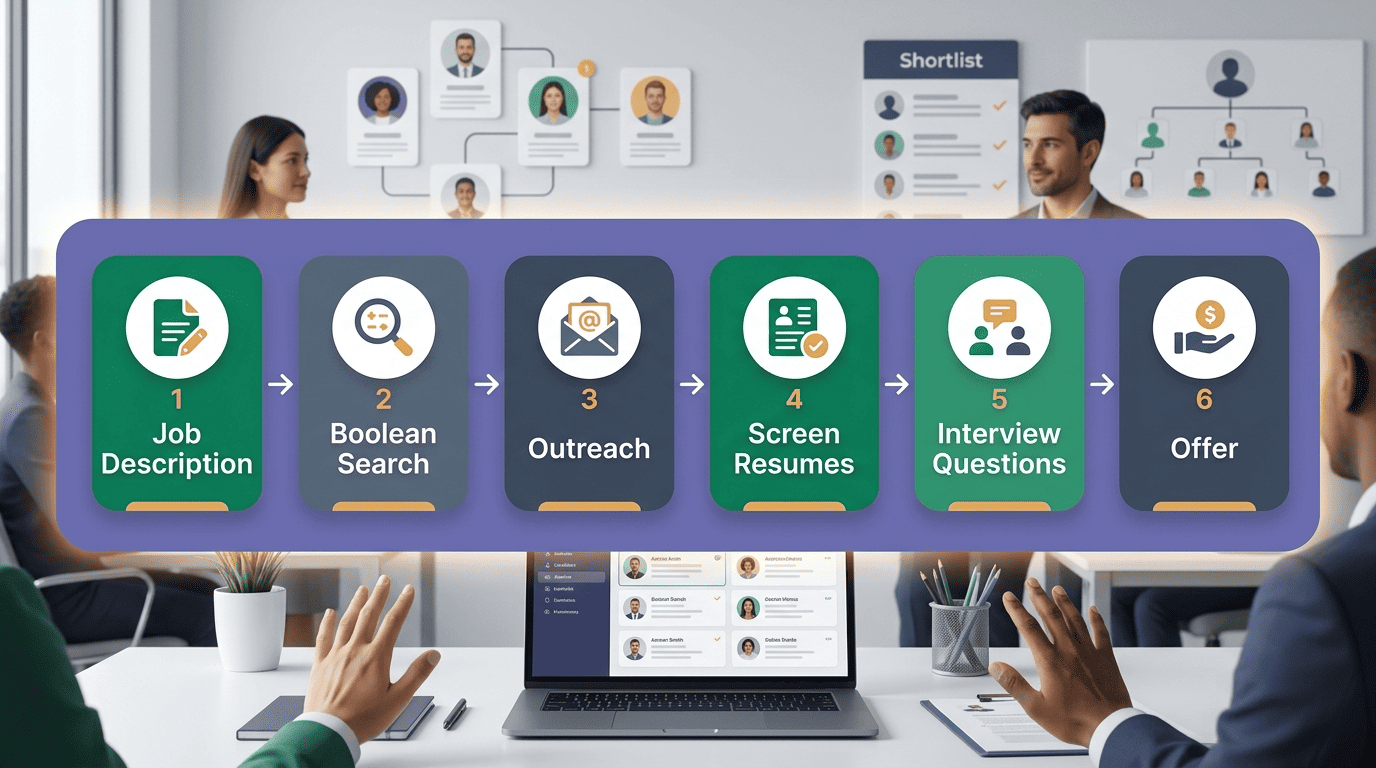
Put together, a full requisition with ChatGPT as a copilot follows roughly this sequence:
- Draft the job description and lock the must-have requirements.
- Generate a boolean/X-ray string and test it on your platform.
- Write and send personalized outreach; queue the follow-up sequence.
- Screen incoming resumes in anonymized batches of five.
- Generate structured interview questions and a scorecard before scheduling.
- Send a human-reviewed offer or a personalized rejection.
- Hand off an onboarding checklist for the candidate’s first week.
Prompt Pack 6 — Offers, Rejections & Onboarding
Even at the finish line, tone matters — candidates can usually tell when an email was generated and not read. Before sending any of the templates below, check that they’re accurate on:
- The candidate’s actual name, role title, and start date
- Compensation and benefits details (never let ChatGPT guess these)
- Company-specific policies (equipment, remote work, probation period)
- Tone — read it aloud once before hitting send
Write a warm, professional offer email for [role] at [company].
Include: congratulations, key details to confirm (start date,
reporting manager), a note on next steps, and an invitation to
ask questions. Keep it under 200 words.
Write an empathetic rejection email for a candidate who made it to
the final round for [role] but was not selected. Acknowledge their
time and effort specifically, avoid generic phrases like "we had
many qualified applicants," and leave the door open for future roles
if appropriate.Create a first-week onboarding checklist and FAQ for a new [role]
hire at [company]. Cover: accounts/access to set up, key people to
meet, first-week goals, and where to find documentation. Format as
a checklist with a short FAQ section underneath.Read every offer and rejection before it goes out — ChatGPT can produce a generic template, but candidates notice unread, unedited AI text, especially at a moment as personal as a rejection.
The Human-in-the-Loop Rule: Bias, Privacy & the Law
This is the section every recruiter using ChatGPT should read before sending a single message. ChatGPT is a powerful drafting tool, but it is not a compliance officer, and it does not carry legal liability — the employer does.
The U.S. Equal Employment Opportunity Commission (EEOC) is launching an initiative to ensure that artificial intelligence (AI) and other emerging tools used in hiring and other employment decisions comply with federal civil rights laws that the agency enforces.
U.S. Equal Employment Opportunity Commission
64% of HR professionals report that AI tools help them filter unqualified candidates faster, per SHRM — but “faster” is not the same as “compliant.” Three things need to happen every time ChatGPT touches a hiring decision.

Verify, don’t trust
ChatGPT can hallucinate — generating plausible-sounding facts, statistics, or even candidate details that are not accurate. Before anything goes out, check:
- Any statistic or fact ChatGPT cited (salary data, market figures, legal requirements)
- Any detail attributed to a specific candidate’s background
- Job requirements that could be unnecessary or exclusionary
- Compliance-sensitive wording (interview questions, offer terms)
Spot-check each of these before an output reaches a job posting, a candidate, or a hiring manager. This applies doubly to anything resembling a factual claim about a specific person.
Protect candidate data
Do not paste candidate PII — names, contact details, addresses, or anything identifying — into the public version of ChatGPT. Anonymize resumes before screening, or use OpenAI’s enterprise offering, which comes with data-handling agreements described in OpenAI’s enterprise privacy policy. If your organization operates in the EU, GDPR governs how candidate data can be processed and stored, regardless of which tool touches it.
Stay compliant and fair
Language models can inherit bias present in their training data, and using one to screen or rank candidates without safeguards risks discriminating on protected characteristics — something the EEOC actively enforces against under existing civil rights law. In New York City specifically, Local Law 144 requires employers using automated employment decision tools to run an independent bias audit and notify candidates that such a tool is in use. None of this is optional, and none of it is something ChatGPT can certify on its own. The final hiring decision, and the responsibility for a fair, compliant process, stays with a human recruiter.