
What Is an AI Recruiter? The Complete Guide to AI-Powered Hiring
An AI recruiter is software that uses artificial intelligence — natural language processing and machine learning — to automate the repetitive parts of hiring: reading resumes, ranking candidates, drafting job posts and interview questions, and reaching out to talent. It screens thousands of applications in minutes and ranks candidates against the role, but it assists rather than decides — a distinction Wikipedia’s entry on artificial intelligence in hiring tracks closely. Below: how it works, what it handles, the ROI, the bias/EEOC risks, and how to pick one.
AI assists; a human makes the final hiring decision and checks for bias/EEOC.
What Is an AI Recruiter?
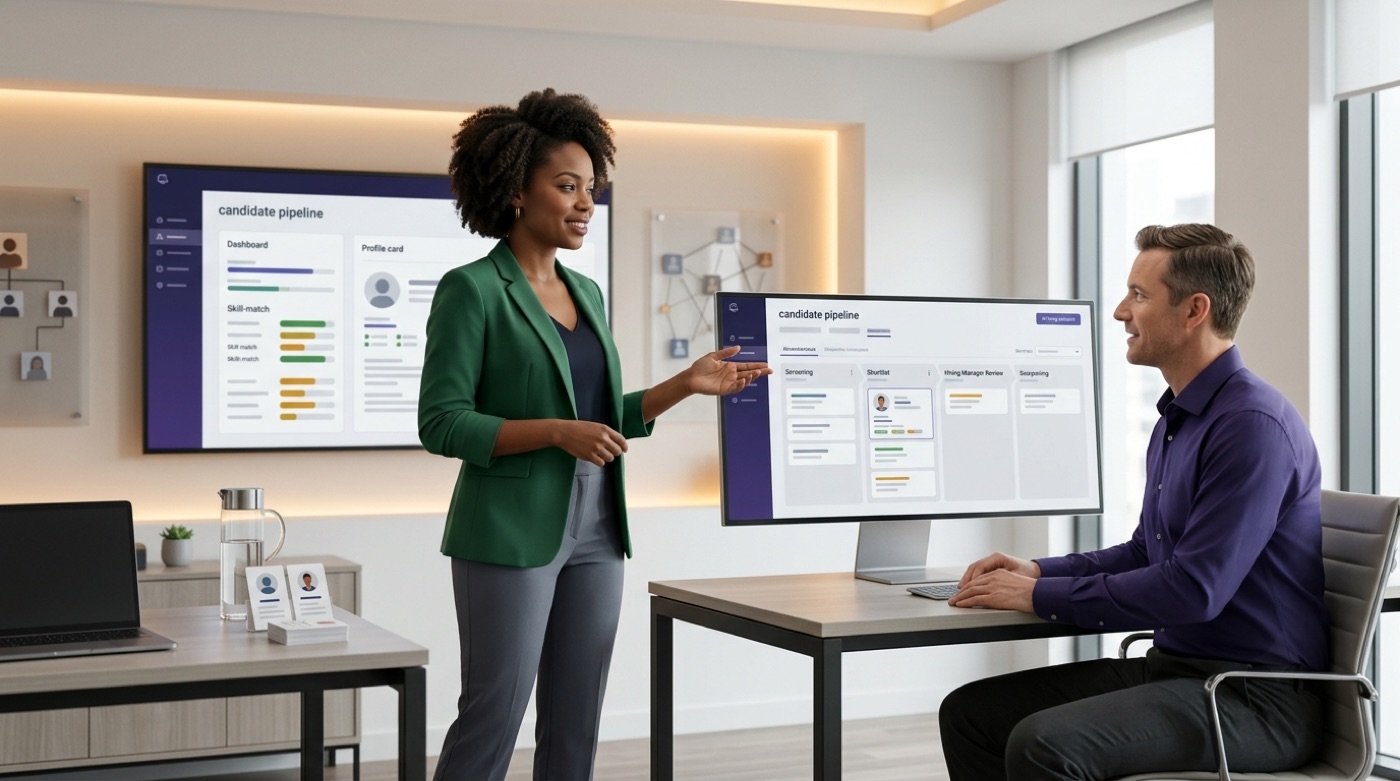
An AI recruiter is an intelligent layer that actively analyzes, predicts, recommends and acts — unlike a traditional Applicant Tracking System (ATS), which mainly stores and organizes applications rather than reasoning about them. The distinction matters because most hiring teams already run an ATS; adding AI recruiting software on top changes what the system does with the data, not just where it lives.
Definition and how it differs from an ATS
An AI hiring tool reads unstructured resume text, learns from past hiring outcomes, and can hold a screening conversation the way a conversational AI recruiter or agentic AI workflow would — chaining together parsing, scoring and scheduling without a human clicking through every step. Adoption is no longer a niche bet: 62% of organizations are already using AI somewhere in the business, though only 46% expect to use it specifically in HR by 2026, according to SHRM’s 2026 State of AI in HR report. The AI-in-recruitment market itself is estimated at $8.16 billion in 2025, projected to reach $15.24 billion by 2030 — a compound annual growth rate near 24.8%, per Grand View Research.
Types of AI used
Four techniques do most of the work. NLP reads unstructured resume text and turns it into structured fields. Machine learning improves matching by learning from which candidates actually got hired and performed well. Predictive analytics forecasts how well a candidate is likely to fit a role before an interview happens. Agentic AI ties these together into a workflow — screen, shortlist, schedule — executing multiple steps in sequence rather than one isolated task.
- Natural language processing (NLP) — reads unstructured resume text
- Machine learning — learns from past hiring outcomes
- Predictive analytics — forecasts candidate-role fit
- Agentic AI — chains screening, shortlisting and scheduling into one workflow
How Does an AI Recruiter Work?
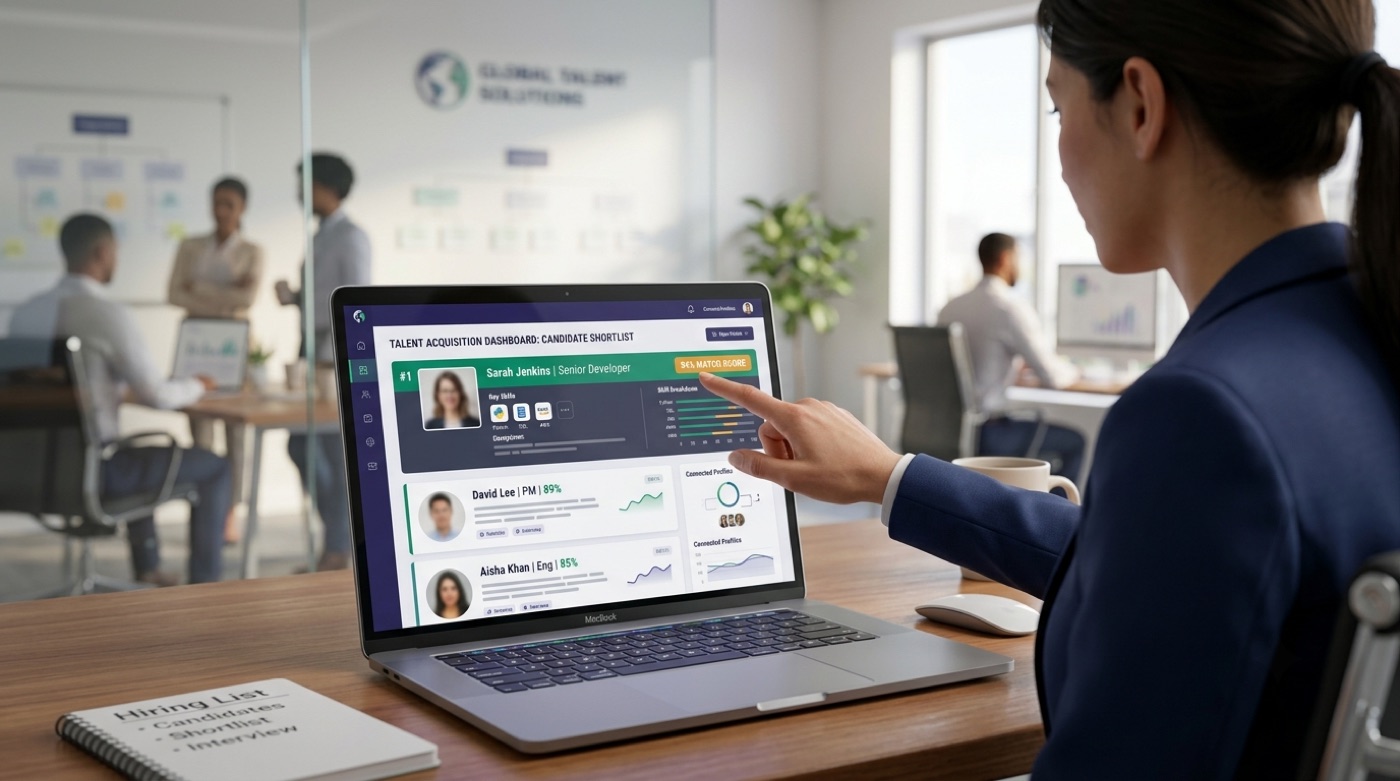
Most platforms follow the same underlying pipeline, whether they’re marketed as an AI recruiting agent, an AI hiring assistant, or a module inside a larger ATS. The mechanics are consistent even when the branding isn’t.
The four-step pipeline
- Parse — extracts work history, skills and education from resumes into structured data.
- Match — compares candidate data to the role model and job description, using context and synonyms rather than exact keyword matches alone.
- Score and rank — assigns a score, often normalized 0-100 against up to 14 job-specific criteria, and shortlists the top candidates.
- Learn — improves from recruiter feedback and real hiring outcomes over time.
The speed difference is the headline number: an AI recruiter can review 1,000+ resumes in under 30 minutes, a task that takes a human recruiting team 40+ hours of manual reading.
False positives and false negatives
No scoring model is perfect. AI recruiting platforms can over-include weak candidates (false positives) or screen out qualified people whose resumes don’t match the expected pattern (false negatives) — which is exactly why the score should function as a guide for a recruiter, not a final verdict.
Core Tasks an AI Recruiter Handles
The table below maps the tasks recruiters used to do manually to what the AI recruiting platform now automates.
| Task | What the AI does |
|---|---|
| Resume screening | Reads, structures and ranks every application against the role in minutes |
| Job description writing | Drafts inclusive, role-accurate postings and flags biased language |
| Interview prep | Generates role-specific questions and structured scorecards |
| Sourcing | Searches 400M-850M+ profiles across 70+ channels using Boolean strings |
| Outreach | Writes and sends personalized candidate messages |
| Scheduling | Books interviews automatically once a shortlist is confirmed |
Resume screening and parsing
The AI reads and structures every application, flags must-have criteria, and ranks candidates against the role. Reviewing at scale — 1,000+ resumes in minutes — cuts screening time by up to 76% compared with manual review.
Writing job descriptions
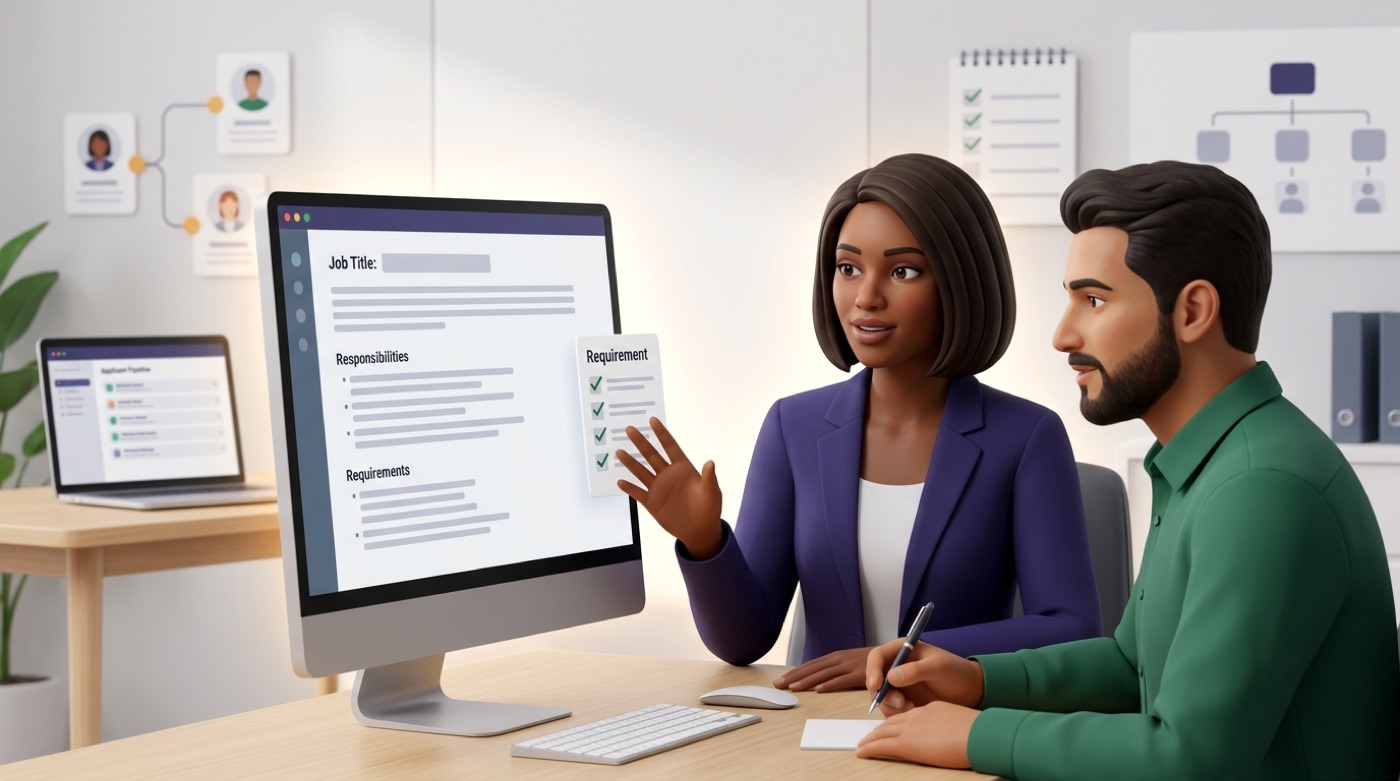
It drafts inclusive, role-accurate job posts from a handful of inputs. Rather than starting from a blank page, a recruiter feeds the tool the role, seniority and must-haves, and the AI recruiter returns a draft with bias-free language suggestions already applied.
It generates role-specific interview questions and scorecards. These give every candidate a common set of criteria, which is the actual foundation of fair, comparable hiring — not the interviewer’s memory of what they asked last time.
It builds and optimizes Boolean search strings for sourcing. Sourcing across 400M-850M+ profiles and 70+ channels only works at speed if the search syntax is precise, and an AI recruiting agent can iterate on that string far faster than a person typing it by hand.
It runs conversational or voice screening and books interviews. The tool asks pre-set questions by chat or voice, summarizes the responses, schedules the interview automatically, and hands a shortlist to the human recruiter for the actual decision.
Benefits of Using an AI Recruiter
The business case rests on three numbers: speed, cost, and hire quality — measured against a baseline that most HR teams already recognize as painful.
Speed and cost
AI recruiting software cuts time-to-hire by roughly 50-70% and reduces screening time by about 75%. That matters against a baseline cost-per-hire above $4,700 and a typical 40-44 day time-to-hire — the savings compound with every requisition the tool touches.
Quality and candidate experience
Firms that lean on data and AI in recruiting are about 46% more likely to make a successful hire, per Harvard Business Review, and consistent scorecards reduce the risk of a costly bad hire — which the US Department of Labor estimates at roughly 30% of the employee’s first-year earnings. Faster responses also help against the roughly 92% of candidates who abandon a job application if the process drags or feels clunky.

Bias, Fairness and EEOC Compliance
AI assists; a human makes the final hiring decision and checks for bias/EEOC.
The legal ground rules
There is no AI-specific US hiring law yet, but AI recruiting tools fall under existing anti-discrimination law enforced by the EEOC:
- Title VII of the Civil Rights Act — applies to employers with 15+ employees
- The Americans with Disabilities Act (ADA)
- The Age Discrimination in Employment Act (ADEA)
The EEOC applies the “four-fifths” (80%) rule to spot adverse impact in a selection tool:
A selection rate for any race, sex, or ethnic group which is less than four-fifths (4/5) (or eighty percent) of the rate for the group with the highest rate will generally be regarded by the Federal enforcement agencies as evidence of adverse impact.
Uniform Guidelines on Employee Selection Procedures, 29 C.F.R. § 1607.4(D)
Crucially, the employer stays legally liable even when the AI recruiter was bought as a vendor product — outsourcing the screening does not outsource the responsibility.
Real cases and local rules
The EEOC’s first AI-hiring settlement, in August 2023, hit iTutorGroup with a $365,000 consent decree for a tool that auto-rejected women 55+ and men 60+. New York City’s Local Law 144 (AEDT) has required an independent bias audit and candidate notice for automated employment decision tools since July 5, 2023, with penalties running $500-$1,500 per violation. Separately, Mobley v. Workday is testing whether an AI vendor itself, not just the employer, can be held liable for a discriminatory tool. The American Bar Association’s analysis walks through how these threads intersect.
Staying compliant
- Run an independent bias audit at least annually.
- Keep audit logs and scoring rationale for every requisition.
- Disclose AI use to candidates where required (e.g., NYC LL144).
- Set explainability requirements before signing with a vendor.
- Keep a human reviewer in every key decision, not just the final signature.
- Re-check EEOC and state-law guidance as it updates.
- Document the bias-audit results in case of a complaint or audit.
AI assists; a human makes the final hiring decision and checks for bias/EEOC.
AI Recruiter vs. Human Recruiter vs. ATS
| AI recruiter | Human recruiter | ATS | |
|---|---|---|---|
| Best at | Volume, consistency, speed | Judgment, empathy, closing candidates | Storing and tracking applications |
| Makes final hiring decisions | No | Yes | No |
| Learns from outcomes | Yes (ML) | Yes (experience) | No |
| Regulatory exposure | High (EEOC/AEDT) | Shared | Low |
AI handles volume and consistency; humans handle judgment, empathy, closing candidates and the final decision; the ATS is the system of record underneath both. An AI recruiter augments the human recruiter and the ATS — it does not replace either. The compliance risk is real: recent hiring-technology surveys found that 75% of companies still let AI reject candidates without human review, even though 71% say they maintain human oversight — the exact gap regulators are targeting.

How to Choose an AI Recruiter
Run the checklist below before signing a contract:
- ATS/HRIS integration that doesn’t require re-entering candidate data
- A documented, independent bias audit and explainable scoring (not a black box)
- Human-in-the-loop controls, including an override or kill switch
- Data security certifications such as ISO 27001 or SOC 2 Type II
- Alignment with EEOC guidance, NYC Local Law 144, and the EU AI Act where relevant
- Honest ROI expectations — the payoff is largest on high-volume roles, roughly 200+ applications per requisition
Explore AI recruiter guides
- AI recruiter for resume screening
- AI recruiter for writing job descriptions
- AI recruiter interview questions
- AI recruiter for candidate outreach
- AI recruiter boolean search strings
- AI recruiter for LinkedIn recruiting
- AI recruiter and hiring bias (EEOC compliance)
- ChatGPT as an AI recruiter
- AI recruiter vs human recruiter
- AI recruiter for small business hiring
- AI recruiter for candidate evaluation and scorecards
- Free AI recruiter tools
Frequently Asked Questions
- What is an AI recruiter?
Software that uses AI (NLP + machine learning) to automate resume screening, candidate ranking, outreach, interview questions and scheduling — assisting recruiters, not replacing them.
- How does an AI recruiter work?
It parses resumes into structured data, matches them to the role, scores and ranks candidates (often 0-100), and learns from hiring outcomes.
- Can AI replace human recruiters?
No. AI handles volume and consistency; humans handle judgment, relationships and the final hiring decision. AI is assistive.
- Is it legal to use AI in hiring?
Yes, but it’s regulated. AI hiring tools must comply with EEOC-enforced laws like Title VII, plus local rules such as NYC Local Law 144 requiring bias audits. The employer remains liable.
- Does AI recruiting introduce bias?
It can if trained on biased data (Amazon scrapped a biased tool in 2018), but audited, well-designed tools can reduce bias meaningfully. Bias audits and human oversight are essential.
- How much does an AI recruiter cost, and when is it worth it?
Pricing ranges widely from per-user monthly plans to enterprise contracts; ROI is strongest on high-volume roles, roughly 200+ applications per requisition.