
AI Recruiter for Resume Screening: How It Works, Benefits, and Staying EEOC-Compliant
AI resume screening reads and ranks incoming applications against your job requirements in seconds, turning a stack of hundreds of resumes into a short, scored shortlist. It’s the core function of an AI recruiter — the Wikipedia entry on the applicant tracking system traces automated resume filtering back decades, but modern natural language processing has made the scoring far more accurate than old keyword matching.

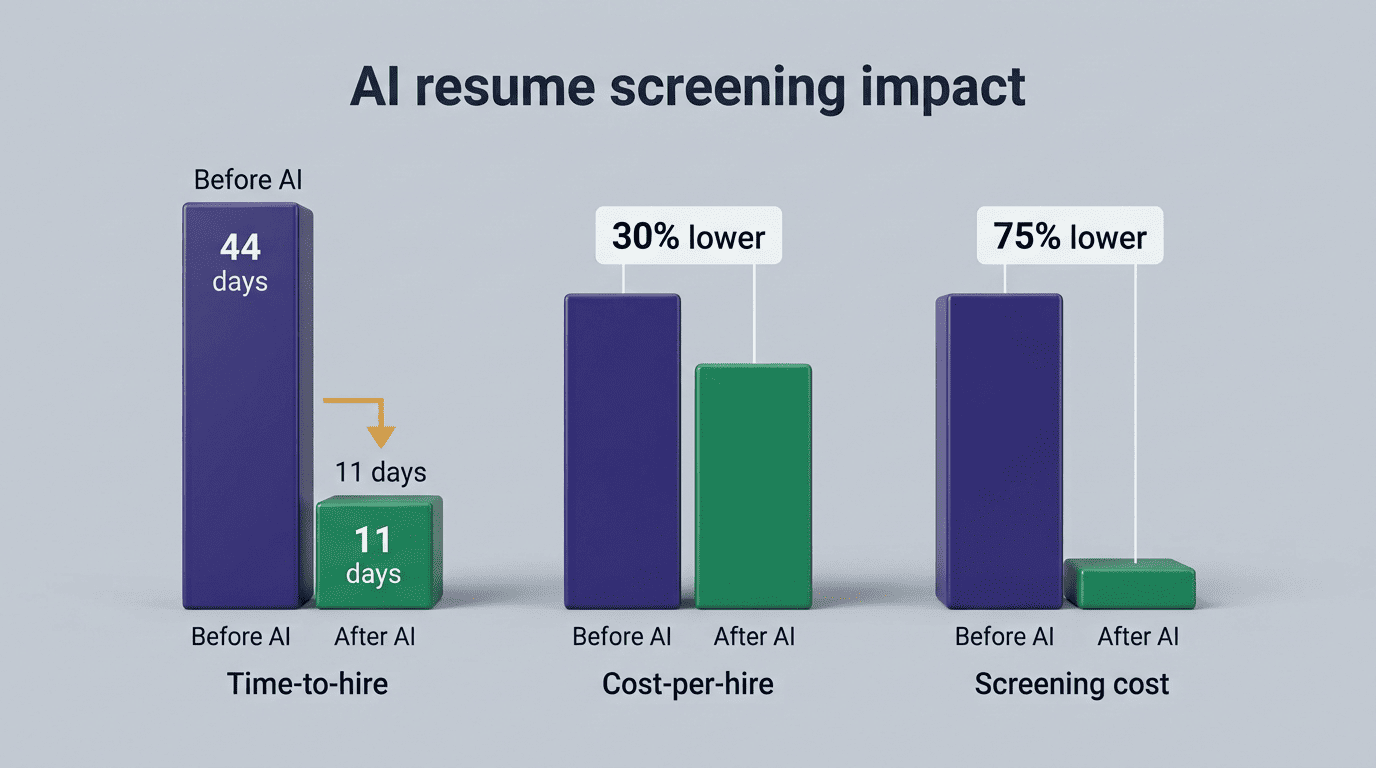
The payoff is real: teams report time-to-hire dropping from 44 days to as few as 11, with cost-per-hire falling around 30%. But screening at machine speed also raises a real duty — the human recruiter, not the algorithm, must make the final call and watch for bias.
What Is an AI Recruiter for Resume Screening?
AI resume screening is software that uses natural language processing (NLP) and machine-learning models to read each resume, extract skills and experience, and score it against a job description. It’s often built into or layered on top of an applicant tracking system, and vendors market it under a handful of overlapping names — AI recruiting assistant, AI recruiting software, or simply an automated resume screening tool.
Definition in plain terms
A recruiter can spend up to 23 hours screening resumes for a single hire, and a typical corporate opening draws around 250 applications, according to Glassdoor data. AI resume screening exists to compress that workload: the model parses each document, extracts structured fields like job titles, tenure, and skills, and produces a numeric match score the recruiter can sort by. Some platforms call this layer an “AI recruiting assistant” because it behaves less like a filter and more like a first-pass reader working alongside the human team.
Where it sits in the hiring stack
Most AI resume screening runs as a module inside an existing applicant tracking system rather than as a standalone product — the ATS still owns job postings, candidate records, and interview scheduling, while the AI layer handles parsing and ranking. Industry estimates suggest roughly 70% of businesses will use AI somewhere in hiring by 2026, and around 82% of employers already rely on some form of AI to sift resumes at the top of the funnel.
How AI Resume Screening Actually Works (Step by Step)
The mechanics are consistent across most tools on the market, even when the branding differs. Each resume moves through the same four-stage pipeline before a human ever opens it.
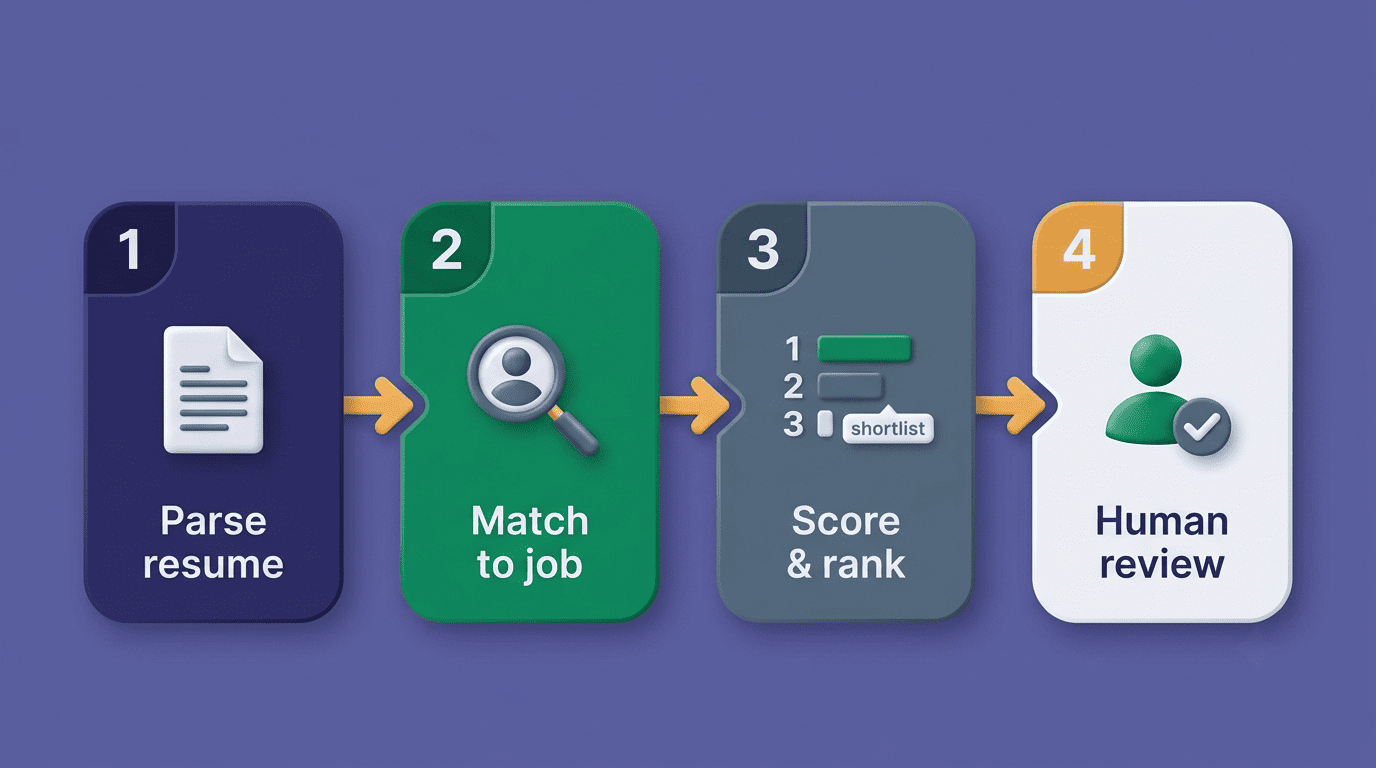
- Parse and normalize the resume. NLP extracts structured data — skills, job titles, tenure, education — from PDF, DOC, or DOCX files. Many platforms offer an anonymization option that strips name, photo, and address to reduce bias before scoring begins.
- Match skills to the job description. The model compares the candidate’s extracted profile against the requirements in the job posting, highlighting overlaps and gaps. Better tools do this contextually — matching “led a five-person engineering team” to a “management experience” requirement — rather than relying on exact keyword hits.
- Score and rank into a shortlist. Each candidate receives a match score, and the recruiter sees a ranked shortlist instead of a flat inbox. Reviewed correctly, this step can make resume review up to 76% faster and return roughly 1.5 days per week to recruiters who previously did this by hand.
- Route to human review. Top-scoring candidates flow to the recruiter for real evaluation, not an automatic hire or reject — see how that human step plays out in candidate evaluation. The AI narrows the pool; the person still decides who moves forward.
The Benefits: Speed, Cost, and Consistency
Faster time-to-hire. Employers using AI-assisted screening report time-to-hire dropping from an average of 44 days to as few as 11, and some report up to 66% shorter cycles overall. That’s not a marginal improvement — it’s the difference between losing a strong candidate to a competing offer and closing them first.
Lower cost and recruiter workload. Cost-per-hire falls by roughly 30%, time-to-fill drops about 25%, and screening costs specifically can fall by up to 75% when the first pass is automated. SHRM’s research on AI in HR has tracked talent acquisition as the leading use case for AI adoption in HR departments, ahead of learning and development or performance management.
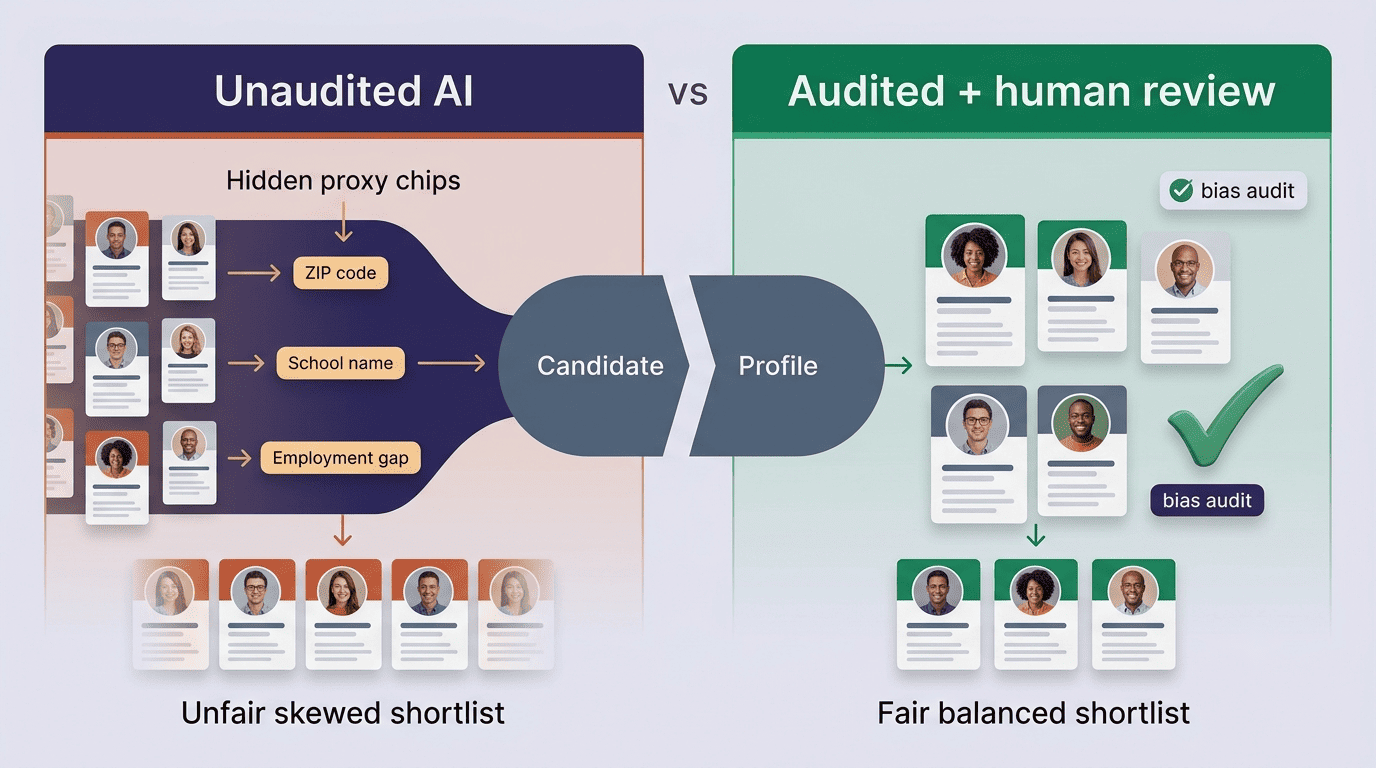
More consistent first-pass screening. Every resume gets evaluated against the same criteria, which reduces the random inconsistency of one recruiter having a bad Monday and skimming past a qualified candidate. That consistency is only a benefit, though, if the underlying model is actually audited — an unaudited model doesn’t remove human bias, it just automates whatever bias was already baked into the training data.
| Metric | Before AI screening | With AI screening |
|---|---|---|
| Time-to-hire | ~44 days | As low as 11 days |
| Cost-per-hire | Baseline | ~30% lower |
| Screening cost | Baseline | Up to 75% lower |
| Recruiter hours per hire | Up to 23 hours | ~1.5 days/week reclaimed |
The Catch: Bias, Fairness, and What Can Go Wrong
Speed and consistency only matter if the scores underneath them are fair, and this is where AI resume screening runs into its hardest problem.
How AI screening can inherit bias
Models learn from historical hiring data, and if that data reflects decades of biased human decisions, the model reproduces the pattern at scale instead of correcting it. Proxies like zip code, school name, and employment gaps can stand in for race, age, or class even when the model never sees a protected characteristic directly. A 2025 Brookings Institution study on language-model resume screening found that Black- and white-associated names were selected at equal rates in only 6.3% of tests — meaning some form of racial disparity showed up in roughly 93.7% of cases — a figure that undercuts any assumption that automation is inherently more neutral than a human reviewer.
An employer can be held responsible under Title VII for selection procedures that use an algorithmic decision-making tool if the procedure discriminates on a basis prohibited by Title VII, even if the tool is designed or administered by another entity, such as a software vendor.— U.S. Equal Employment Opportunity Commission, May 2023 technical assistance guidance (archived; the EEOC removed this page from its site in January 2025, though the underlying Title VII obligations remain in force)
The “black box” problem
If you can’t explain why a candidate scored a 62 instead of an 81, you can’t defend that score to a rejected applicant, a regulator, or your own legal team. Transparency — a model that can point to which resume fields drove the score — isn’t a nice-to-have feature; it’s what makes the tool defensible when someone asks why they didn’t advance.
Staying EEOC-Compliant: The Human Must Decide
An AI recruiter can genuinely speed up and improve first-pass screening, but it does not replace the legal and ethical obligation to make a fair hiring decision. A human recruiter or hiring manager must review flagged candidates, make the final call, and actively check for bias and adverse impact under EEOC rules — the tool’s output is a recommendation, not a verdict, and nothing in this section is legal advice.
Employers stay liable — you can’t outsource it to a vendor
The EEOC’s May 2023 guidance makes clear that employers remain responsible for discriminatory outcomes produced by AI hiring tools, regardless of what the vendor promises about fairness testing. The EEOC pulled this page from its own site in January 2025 following a change in federal AI policy, but that removal doesn’t repeal Title VII or the ADA — both still apply to an AI-screened hiring process exactly as they apply to a manual one, and the software doesn’t create a legal shield.
Adverse impact and the four-fifths rule
If a protected group passes screening at less than 80% of the rate of the highest-passing group, that ratio signals adverse impact under the long-standing four-fifths rule. New York City’s Local Law 144 goes further, requiring covered employers to commission an annual independent bias audit and publish the resulting impact ratios before using an automated employment decision tool — violations can carry civil penalties of up to $1,500 per day. Getting this wrong isn’t cheap: between potential penalties, litigation, and reputational damage, the cost of skipping a bias audit routinely outweighs the cost of commissioning one upfront.
| Requirement | What it covers | Who it applies to |
|---|---|---|
| EEOC Title VII guidance | Employer liable for adverse impact, even from a vendor’s tool | All U.S. employers using AI in hiring |
| Four-fifths rule | Selection rate below 80% of the top group signals adverse impact | Any protected group under Title VII |
| NYC Local Law 144 | Annual independent bias audit + published impact ratios | Employers using AEDTs on NYC-based roles |
| ADA | Reasonable accommodation in the screening process | Candidates with disabilities |
Keep a human in the loop
This is the core disclaimer worth repeating: an AI recruiter should assist and speed up resume screening, but a human must make the final hiring decision, review any flagged or borderline candidates, and audit results for bias and EEOC adverse impact on an ongoing basis. Treat every AI-generated score as a starting point for human judgment, not a substitute for it — and if your organization needs a legal reading of Title VII, ADA, or Local Law 144 obligations, talk to employment counsel rather than relying on this article.
What to Look For in an AI Recruiting Assistant
Must-have capabilities
At minimum, an AI recruiting assistant worth adopting should offer:
- Resume parsing across PDF, DOC, and DOCX formats
- Skill-match scoring against the job description, not just keyword hits
- Explainable scores you can point to when a candidate asks why they didn’t advance
- An anonymization option that strips name, photo, and address
- An audit trail of every score and decision
- Integration with the ATS you already run — most serious tools connect to Workday, Greenhouse, Lever, Bullhorn, Oracle, or UKG rather than asking teams to switch platforms
Fairness and compliance features
Beyond the basics, look for fairness safeguards too:
- An independent bias audit — some vendors partner with third parties such as Warden AI for exactly this
- Impact-ratio reporting you can hand to legal or compliance
- Human-review routing that never lets a score auto-reject a candidate
- The ability to turn off proxy signals that correlate with protected characteristics
How the tool handles the job description side of this — writing postings that don’t themselves introduce bias — matters too; see AI recruiter for job descriptions for that half of the pipeline. For how flagged candidates get a real human look after screening, see AI recruiter candidate evaluation.
How to Roll Out AI Resume Screening (Practical Steps)
Rolling out AI resume screening without a plan is how teams end up with an unaudited model quietly making biased decisions at scale. A short, deliberate rollout avoids that.
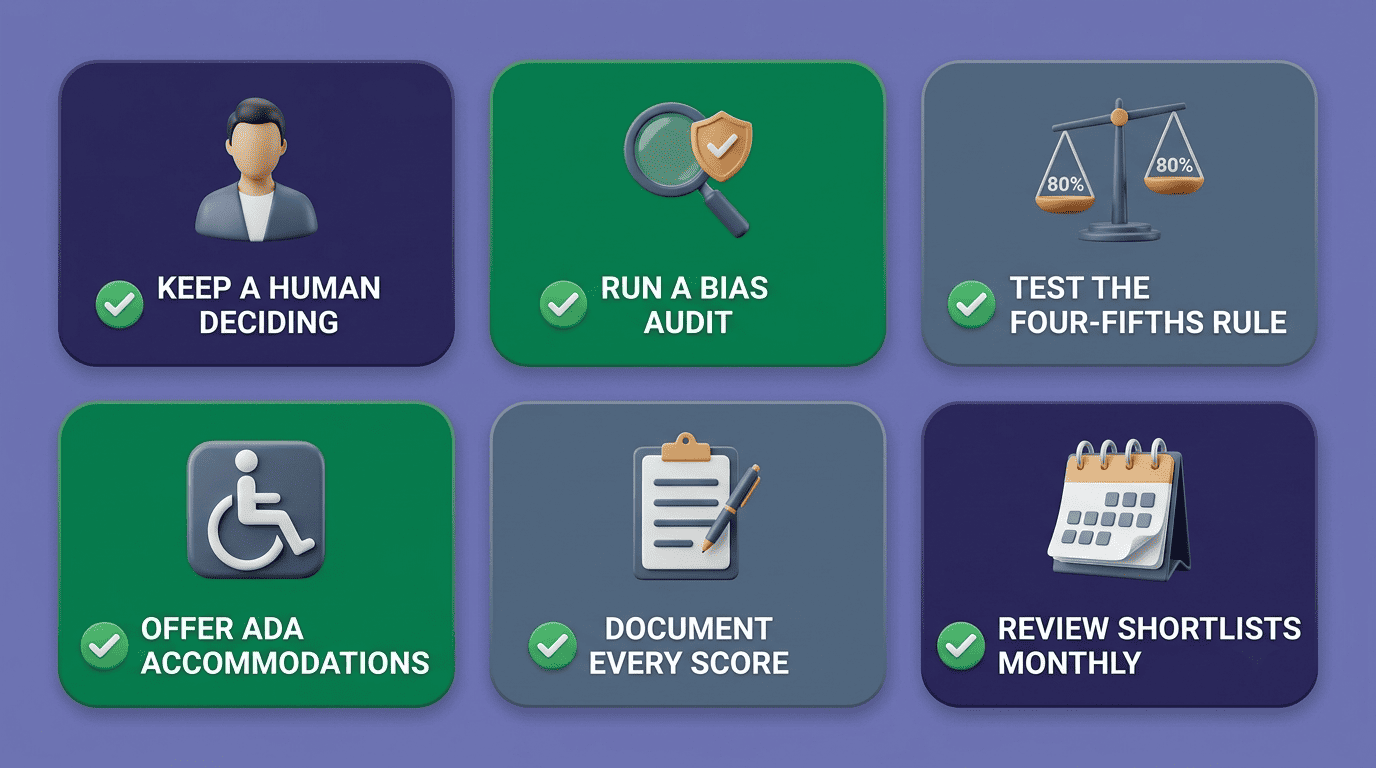
A safe rollout checklist
- Pilot the tool on one high-volume role before deploying it across every requisition.
- Keep a recruiter as the final decision-maker on every candidate the tool touches.
- Run or commission a bias audit before scaling beyond the pilot.
- Document the scoring criteria and keep a record of every candidate’s score.
- Build in ADA accommodations for candidates who request an alternative screening process.
- Review shortlists for adverse impact on a monthly cadence, not just once at launch.