
AI Recruiter and Hiring Bias: How Algorithms Discriminate and How to Stay Compliant
A recruiting algorithm can screen thousands of resumes in minutes — but if it learned from biased hiring history, it can quietly reproduce and even amplify discrimination against protected groups. This guide explains, in plain terms, how an AI recruiter can introduce bias, what U.S. law says about it, and how to audit for bias while keeping a human in charge of the final decision.

The bottom line is simple: AI recruiting tools are legal to use, but under Title VII, the U.S. Equal Employment Opportunity Commission treats the employer — not the vendor — as responsible if the tool discriminates. “The algorithm did it” is not a defense under federal or state employment law.
This article is general information, not legal advice. An AI recruiter can introduce or amplify bias; a qualified human must audit for bias and make the final hiring decision. Consult a licensed employment attorney for compliance.
Can an AI Recruiter Really Be Biased?
Yes, and it does not need to see a candidate’s race, sex, or age to do it. An AI hiring tool builds its scoring logic from patterns in historical data, and those patterns can carry forward whatever algorithmic bias already existed in a company’s past hiring decisions.
Bias comes from the data, not a line of code
AI recruiters learn patterns from historical hiring data. If past hiring favored one group, the model treats that group’s characteristics as the “success” pattern and scores similar candidates higher, creating a feedback loop that reinforces the original bias rather than correcting it.
Researchers at Stanford’s Institute for Human-Centered AI have reported that roughly 90% of U.S. employers now use some form of AI screening in hiring. Their large-scale audit — covering 3.4 million people and about 4 million applications across 150 employers — found that 26% of Black applicants and 15% of Asian applicants applied to positions where the AI-driven process disadvantaged their group relative to others; the researchers estimated that at parity, roughly 40,000 more applications from those groups would have advanced to the next stage.
Proxy variables: bias by another name
Even when an AI screening tool never uses race, gender, or age directly, it can still discriminate through proxy variables that correlate with protected characteristics:
- Zip code or neighborhood
- First and last name
- College or university attended
- Employment gaps on a resume
- Listed hobbies or affiliations
A University of Washington study in 2024 found that AI resume-screening models preferred white-associated names in about 85.1% of trials, compared with about 8.6% for Black-associated names, using otherwise identical resumes.
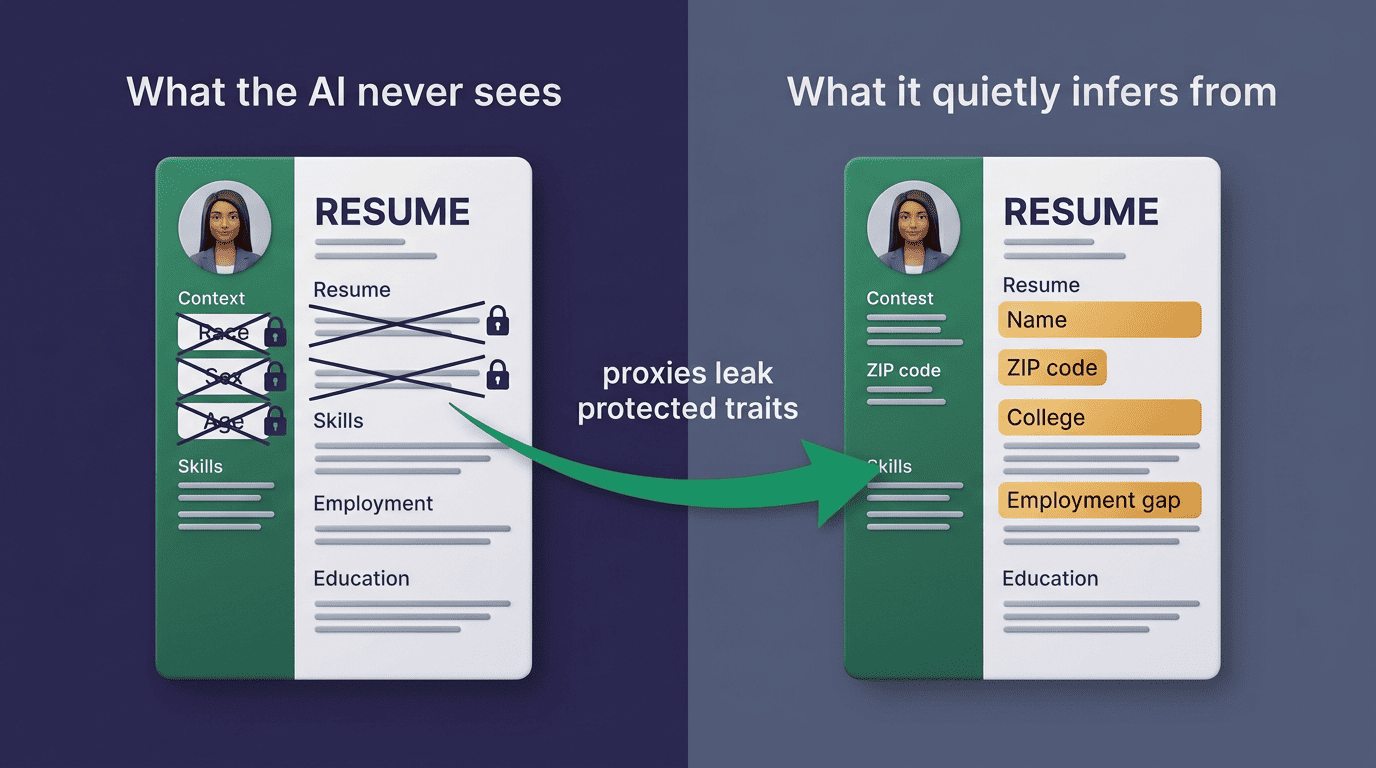
This is what makes algorithmic hiring hard to police from the outside: a vendor’s dashboard might show a candidate a “72% match” score with no visible explanation of which inputs drove it up or down, leaving proxy bias invisible unless someone runs a targeted bias audit.
The three main sources of bias
Practitioners generally group algorithmic hiring bias into three sources, and one industry breakdown from JobsPikr puts rough figures on each:
- Training-data bias (the historical hiring record itself) — attributed to roughly 61% of observed bias.
- Algorithmic bias (how the model weights and combines features) — attributed to roughly 25%.
- Input or interaction bias (how candidates present themselves to the system, which can itself be uneven across groups) — attributed to roughly 14%.
Treat this split as a single vendor’s estimate rather than a settled, peer-reviewed figure — but it illustrates that most of the problem originates upstream, in the data, not in the code.
Real Cases: When AI Recruiting Went Wrong
Three cases show how these mechanisms play out in practice, from a shelved internal project to a regulatory settlement to ongoing federal litigation.
| Case | Year | Allegation / finding | Outcome |
|---|---|---|---|
| Amazon internal recruiting tool | 2014–2018 | Penalized resumes containing “women’s” and downgraded graduates of two all-women’s colleges | Scrapped by Amazon; never used to make live hiring decisions |
| EEOC v. iTutorGroup | 2023 | Automatically rejected female applicants 55+ and male applicants 60+ | $365,000 settlement for violating the ADEA |
| Mobley v. Workday | Ongoing (filed 2023) | Alleges AI screening rejected an applicant based on race, age, and disability | Court allowed key claims to proceed; nationwide collective action permitted on the age claim in May 2025 |
Amazon scrapped its AI recruiter for penalizing women
Between 2014 and 2017, Amazon built an experimental tool that scored resumes on a 1-to-5 star scale. Trained on ten years of resumes submitted mostly by men, the model learned to penalize the word “women’s” — as in “women’s chess club captain” — and to downgrade graduates of two all-women’s colleges. According to Reuters reporting, Amazon’s engineers could not make the tool reliably gender-neutral, and the company scrapped the project by 2018 without ever using it to evaluate real candidates.
EEOC v. iTutorGroup: the first AI-hiring settlement
In 2023, the U.S. Equal Employment Opportunity Commission settled its first-ever AI-hiring discrimination lawsuit. iTutorGroup’s application software was programmed to automatically reject female applicants aged 55 and older and male applicants aged 60 and older, screening out more than 200 qualified U.S.-based applicants. The company paid $365,000 to resolve claims that the practice violated the Age Discrimination in Employment Act (ADEA).
Everyone loses when employers engage in age discrimination.
Timothy Riera, then Acting Director, EEOC New York District Office
This settlement put employers on notice that an AI vendor’s screening code does not shield a company from ADEA liability.
Mobley v. Workday: can the software be an “agent”?
Derek Mobley alleges that Workday’s AI-powered screening tools rejected him from more than 100 jobs based on his race, age, and disability. A federal court has allowed key claims in the case to proceed and treated the possibility that Workday’s tool acted as an “agent” of the employers using it as a live legal question, rather than dismissing it outright. In May 2025, the court permitted a nationwide collective action to proceed on the age-discrimination claim. As of this writing the case remains active litigation — these are allegations under review by the courts, not proven findings of discrimination.
Is It Legal to Use an AI Recruiter? Who Is Liable?
Using an AI recruiting assistant to screen candidates is legal in the United States. The legal risk sits with how it’s used and who answers for the outcome — and that answer is almost always the employer, not the software vendor.
Yes — but the employer carries the legal risk
Under Title VII of the Civil Rights Act, the EEOC’s position is that an employer can be held responsible for a discriminatory selection procedure even when an outside vendor built or operates the underlying tool. Outsourcing the screening step does not outsource the legal liability. This distinction matters when comparing fully automated screening against a hybrid process — see how an AI recruiter compares with a human recruiter on accountability and final-decision authority.
The federal laws that apply
| Law | Protects against discrimination based on | Applies to employers with |
|---|---|---|
| Title VII of the Civil Rights Act | Race, color, religion, sex, national origin | 15 or more employees |
| Age Discrimination in Employment Act (ADEA) | Age (40 and older) | 20 or more employees |
| Americans with Disabilities Act (ADA) | Disability | 15 or more employees |
Discrimination claims generally fall into two categories: disparate treatment, where someone is intentionally treated differently because of a protected characteristic, and disparate (adverse) impact, where a neutral-looking policy or tool disproportionately screens out a protected group regardless of intent. Most AI hiring cases are adverse-impact cases — nobody has to prove the algorithm “meant” to discriminate, only that its outcomes did.
How Hiring Bias Is Measured: The Four-Fifths Rule
Regulators and auditors need a consistent yardstick to flag potential adverse impact before it becomes a lawsuit. That yardstick is the four-fifths rule.
What the four-fifths (80%) rule says
The EEOC’s Uniform Guidelines on Employee Selection Procedures (29 CFR Part 1607) set out the four-fifths rule as a rule of thumb: if a group’s selection rate is less than four-fifths (80%) of the rate for the group with the highest selection rate, that difference is generally regarded as evidence of adverse impact. It is a screening indicator, not automatic proof of illegal discrimination.
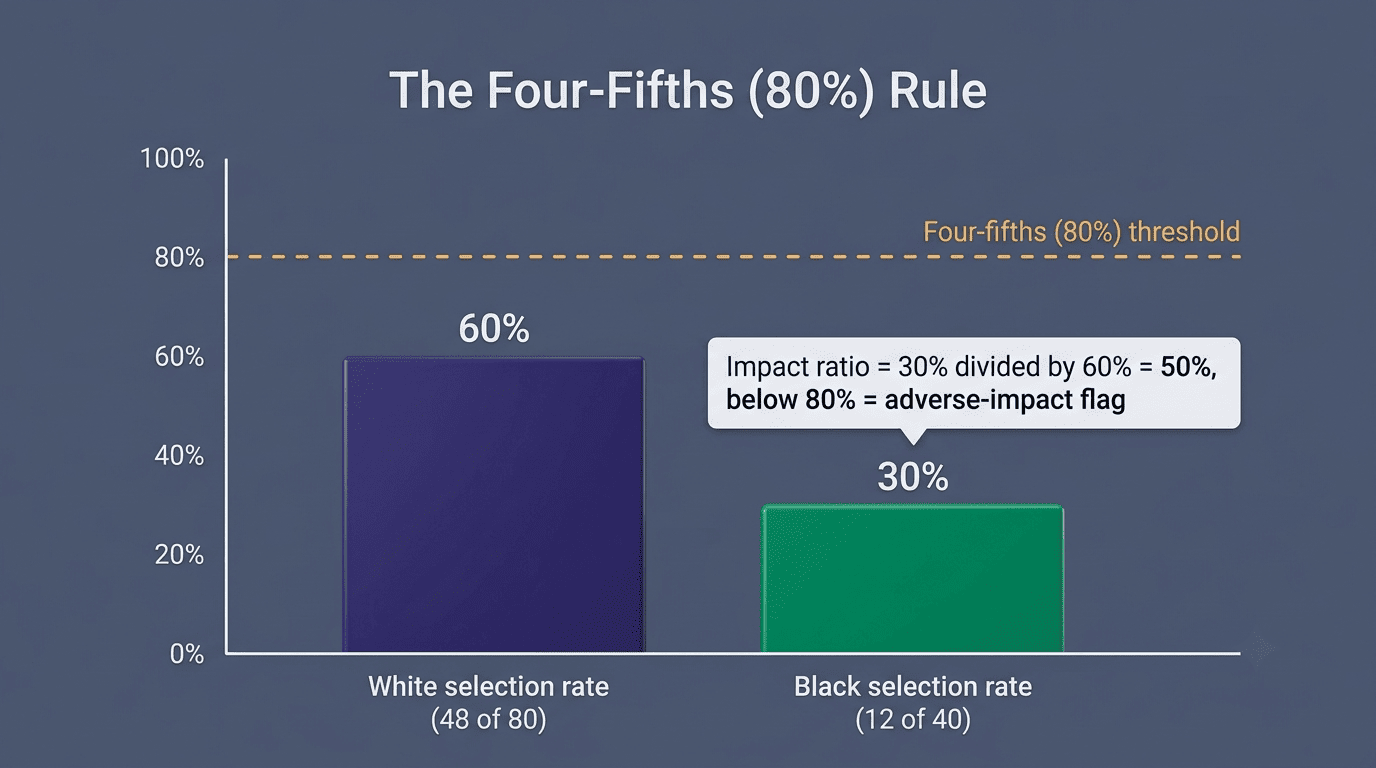
The EEOC’s own worked example illustrates the math: if the white selection rate is 48 out of 80 applicants (60%) and the Black selection rate is 12 out of 40 applicants (30%), the impact ratio is 30% divided by 60%, or 50%. Because 50% is below the 80% threshold, the four-fifths rule indicates adverse impact and warrants closer review.
- Calculate the selection rate for each demographic group (number selected divided by number of applicants in that group).
- Identify the group with the highest selection rate.
- Divide each other group’s selection rate by that highest rate to get an impact ratio.
- Flag any group whose ratio falls below 80% (four-fifths) as a potential adverse-impact signal.
- Investigate flagged stages further — job relevance, business necessity, and less discriminatory alternatives — before drawing conclusions.
Why AI can hide adverse impact
Stanford’s research points to a subtler risk: pooling results across many different jobs and requisitions can mask adverse impact that is clearly visible when a single position is examined on its own. Because one vendor’s model can score millions of applications across many employers at once, it can produce what researchers describe as “systemic rejection” — the same candidates getting screened out again and again across unrelated job postings, even when no individual employer’s numbers look alarming in isolation.
What U.S. Law Requires: EEOC, NYC Local Law 144, and State Rules
Federal anti-discrimination law sets the baseline, but a growing patchwork of state and city rules adds specific, procedural requirements for automated hiring tools.
NYC Local Law 144: mandatory bias audits
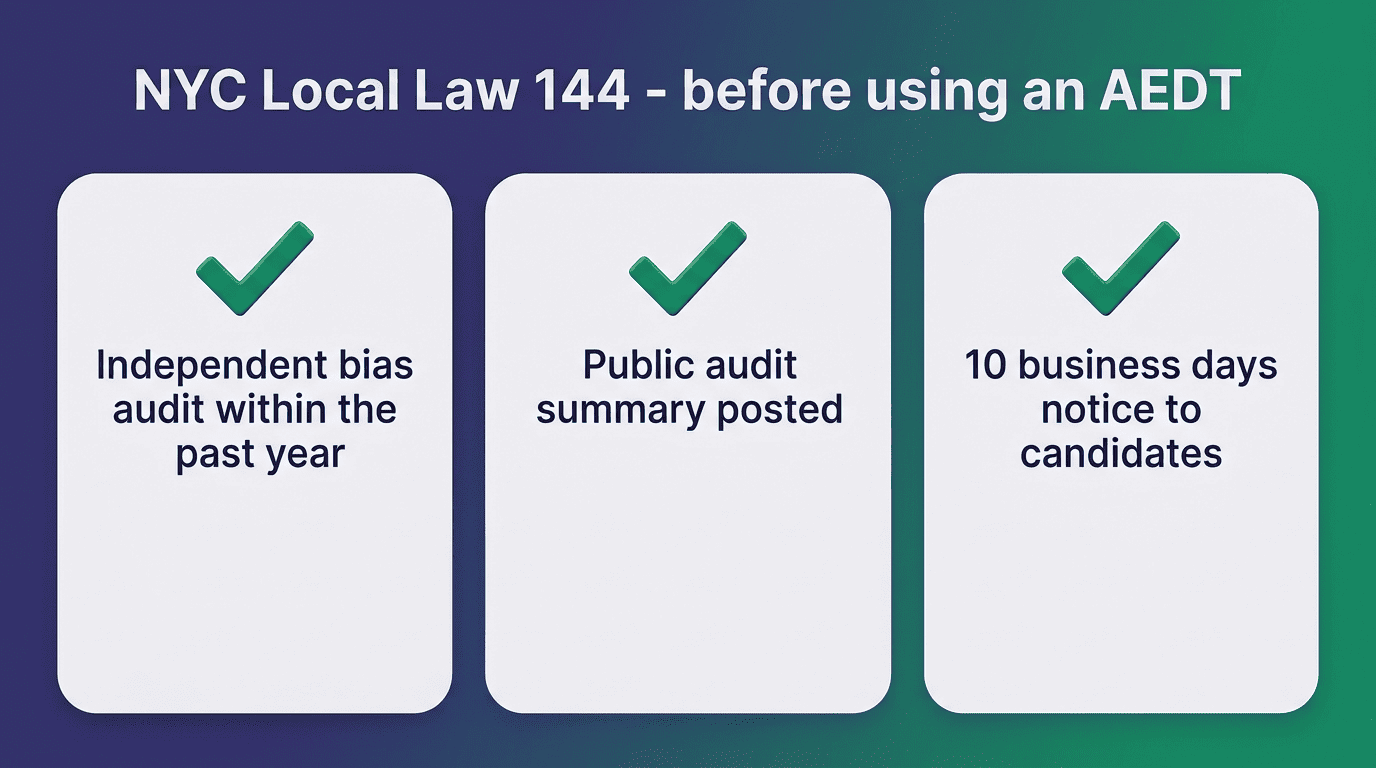
New York City’s Local Law 144 has been enforced since July 5, 2023. It prohibits an employer or employment agency from using an automated employment decision tool (AEDT) to screen candidates in New York City unless three conditions are met:
- An independent bias audit of the tool has been completed within the past year.
- A summary of that audit is posted publicly.
- Candidates and employees receive at least 10 business days’ notice before the tool is used to evaluate them.
Violations carry penalties of $500 for a first offense and up to $1,500 per day for continuing violations.
A patchwork of state and local laws
Other jurisdictions have layered on their own rules, and some are moving targets. Illinois’s AI Video Interview Act requires notice and consent before AI analyzes video interviews and requires employers to delete submitted video within 30 days of a candidate’s request. Colorado’s original AI Act, signed in 2024, would have required developers and deployers of high-risk AI systems — including hiring tools — to use reasonable care to prevent algorithmic discrimination; before that provision took effect, Colorado repealed and replaced it with a narrower law (effective January 1, 2027) that drops the standalone algorithmic-discrimination duty of care in favor of notice, human-review, and record-retention requirements for high-impact automated decisions. California has also adopted automated-decision regulations affecting employment tools, effective in 2025. Because these requirements differ by jurisdiction and continue to change, verify current obligations with counsel before deploying or renewing any AI recruiting software.
How to Audit an AI Recruiter for Bias
A bias audit is not a one-time checkbox — it’s an ongoing discipline that combines statistical testing with a hard rule about who makes the final call.
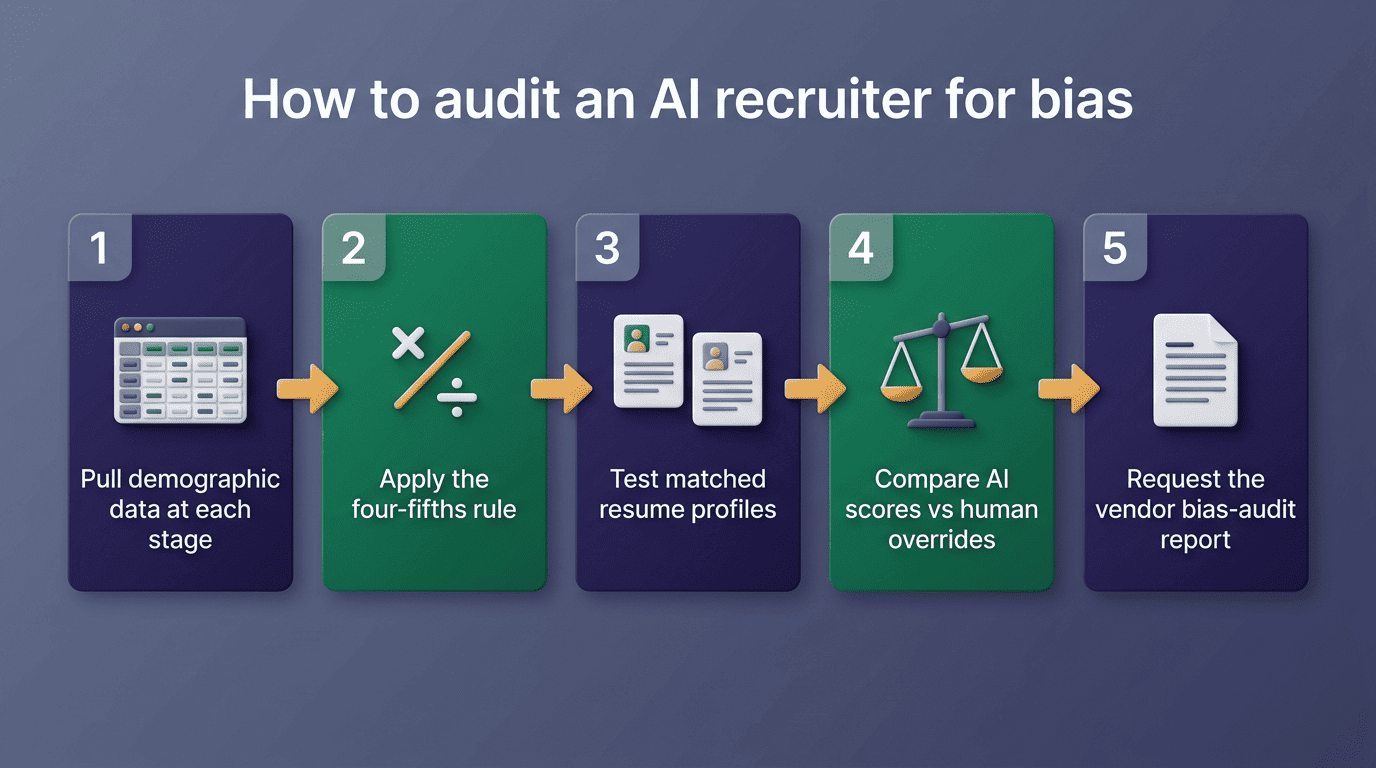
Pull demographic data at every pipeline stage. Track who applies, who advances to interview, and who receives an offer, broken out by protected group, so gaps are visible before they compound.
Apply the four-fifths rule at each stage. Compare progression rates between groups the same way the EEOC does in its worked example, and flag any ratio below 80% for closer review rather than dismissing it.
Test matched candidate profiles. Submit resumes that are identical except for a name, a graduation year, or a zip code associated with a particular demographic group, and compare how the AI screening tool scores them to expose proxy bias directly.
Compare AI scores against human overrides. When recruiters routinely override the AI in one direction for a particular group, that pattern is worth investigating on its own — it can reveal either a flaw in the model or a bias in how staff use it.

Request the vendor’s independent bias-audit report. Under frameworks like NYC’s Local Law 144, a compliant vendor should already have this documentation; asking for it — and for the raw selection-rate data behind it — is a reasonable due-diligence step before signing or renewing a contract. This due-diligence step matters even more once a tool starts producing AI candidate evaluations that recruiters rely on to shortlist people.
Keep a human in the loop — and in charge
AI should augment a recruiter’s judgment, not replace it. Research cited by the World Economic Forum found that recruiters followed AI recommendations without questioning them in roughly 85% of decisions — a pattern known as automation bias, where people defer to an algorithm’s output even when they have reason to double-check it. Human-plus-AI review, along with blind or anonymized screening at early stages, is associated in vendor and academic reports with lower rates of biased outcomes, though specific percentages vary by source and shouldn’t be treated as guarantees. The principle that holds regardless of the tool: a qualified human must audit an AI recruiting software system for bias and make the final hiring decision.
FAQ
None of this replaces individualized legal counsel. Employment-discrimination law is fact-specific, varies by state and city, and continues to change as courts rule on cases like Mobley v. Workday.
This article is general information, not legal advice. An AI recruiter can introduce or amplify bias; a qualified human must audit for bias and make the final hiring decision. Consult a licensed employment attorney for compliance.