
AI Recruiter for Candidate Evaluation and Scorecards: How Scoring Actually Works
An AI recruiter turns messy, inconsistent hiring into a repeatable scoring system — an AI recruiter reads each candidate against the same rubric and returns a structured scorecard with a number and the evidence behind it. That structure is what lets a recruiting team compare candidate 3 and candidate 300 on equal footing instead of relying on whoever remembers the interview best.
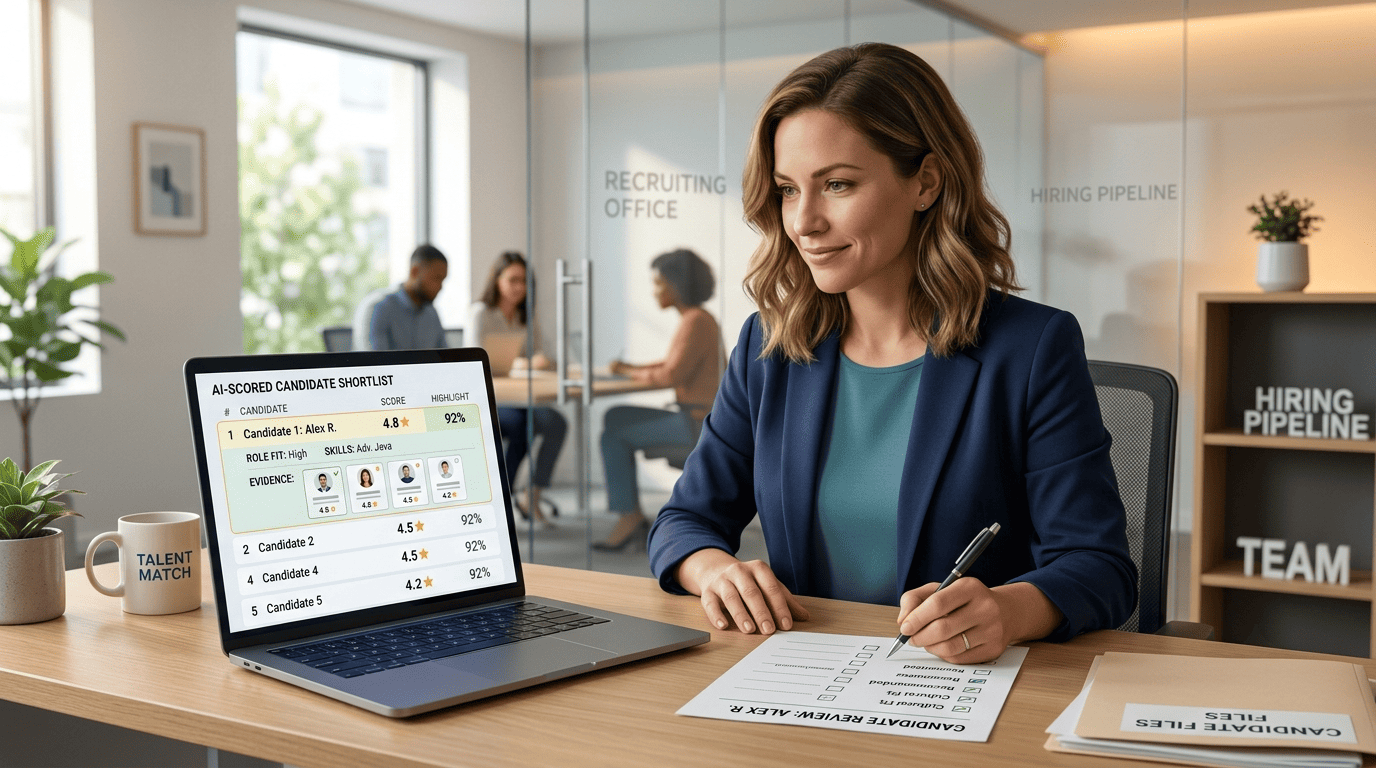
The goal isn’t to let software “pick” people — it’s to give every applicant the same fair, documented evaluation so a human can decide faster. That’s the guardrail worth stating up front: AI assists; a human makes the final hiring decision and checks for bias/EEOC. Everything below explains how the scoring actually works, and where that human checkpoint has to sit.
What Is an AI Candidate Scorecard?
An AI candidate scorecard is a structured, evidence-backed record of how one applicant performed against a defined set of hiring criteria. It’s the output of the evaluation, not the evaluation itself — the rubric is the standard, and the scorecard is what gets filled in when a real candidate is measured against it.
Scorecard vs. traditional gut-feel screening
An AI candidate scorecard is a weighted set of evaluation factors with a 1-5 rating scale applied to every candidate the same way. Unlike ad-hoc screening, where one interviewer’s notes might say “good communicator” and another’s say nothing at all, the scorecard produces a number per factor plus a written rationale and the evidence — a resume line, an interview answer — behind each score.
That consistency is the entire point. Traditional gut-feel screening lets two equally qualified candidates get wildly different treatment depending on who happened to interview them, what mood that person was in, or which resume they read first that day. A scorecard removes the variance without removing the judgment call at the end.
What’s on a scorecard
A typical AI candidate scorecard mixes job-specific and organizational criteria rather than scoring on a single overall impression. A common structure looks like this:
- 4-6 job-specific competencies tied directly to the role (technical skill, relevant experience, domain knowledge)
- 1-2 organizational or culture-fit competencies shared across roles
- A 1-5 rating scale per factor, sometimes supplemented with yes/no or open-text fields
- Written AI feedback per factor explaining why the score landed where it did
| Factor | Weight | Example score (1-5) |
|---|---|---|
| Core technical skill | 30% | 4 |
| Relevant experience | 25% | 3 |
| Communication | 15% | 5 |
| Problem-solving | 15% | 4 |
| Culture/values fit | 15% | 3 |
The AI attaches feedback per factor so reviewers see the reasoning, not just the number — a hiring manager scanning a scorecard should be able to tell in seconds why a candidate scored a 3 on experience instead of a 5.
How an AI Recruiter Scores and Ranks Candidates
Scoring isn’t a single step — it’s a pipeline that starts the moment an application lands and ends with a ranked list a recruiter can actually act on.
Inputs the AI reads
The scoring engine analyzes the resume, the job description, and interview responses — often gathered through a one-way video or voice interview — mapping evidence back to each rubric factor. Several signals feed this process at once:
- Resume parsing and keyword/skills matching, which produce a match score against the job description
- Structured interview answers, scored against the rubric in near real time as the candidate responds
- Job-description requirements, used as the baseline every other signal gets compared to
- Prior scorecard data, when available, for calibration across roles
This pairs directly with how the front end of the funnel works — see AI recruiter resume screening for how the parsing and match-scoring step is built before a candidate ever reaches the scorecard stage.
From scores to a ranked shortlist
Factor scores roll up, with their assigned weights, into an overall candidate score, and the AI ranks applicants into a shortlist with evidence summaries attached to each entry. This is where the time savings actually show up: picture a team running 140 candidates across 7 roles over 4 weeks — auto-shortlisting 41 of them (29% of the pool) and saving roughly 15 recruiter hours that would otherwise have gone into first-pass reading.
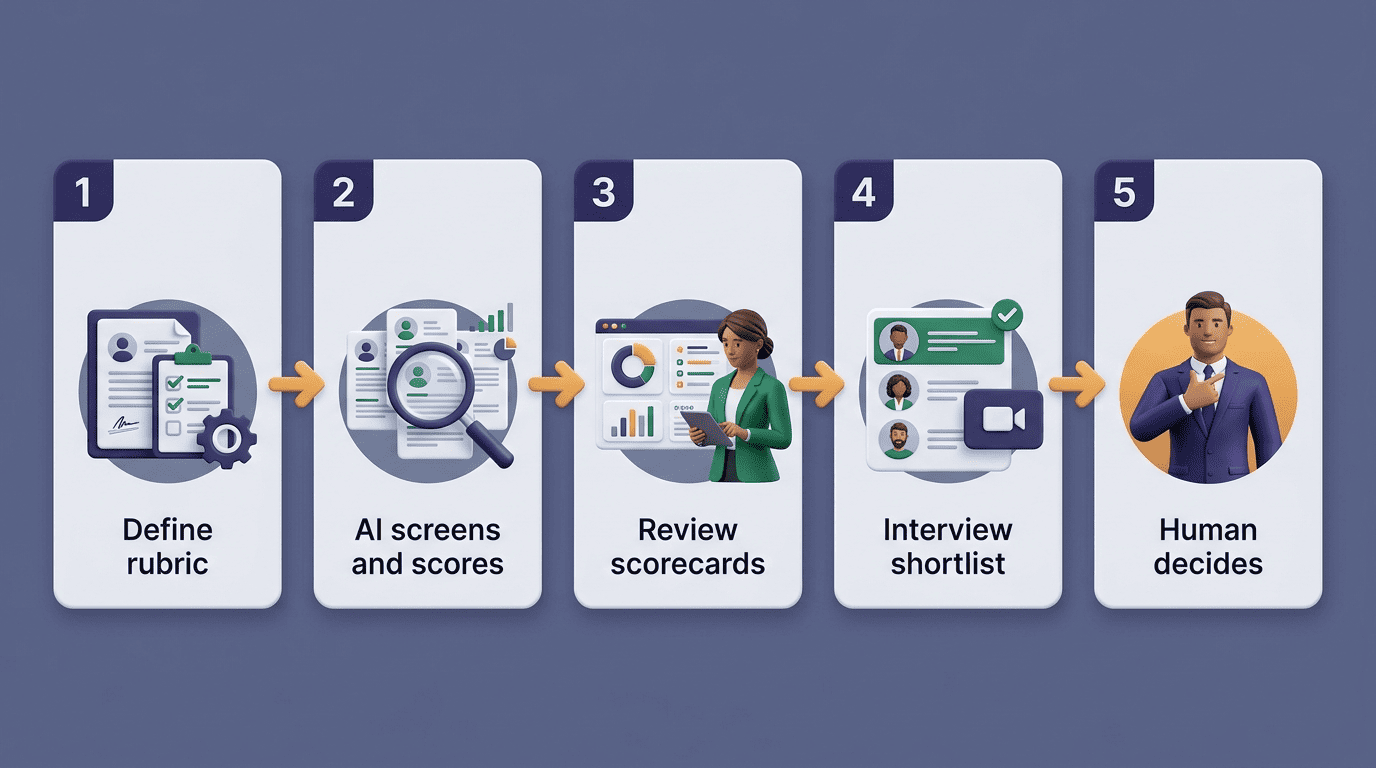
What a recruiter actually sees on that ranked shortlist:
- The overall weighted score for each candidate, highest first
- A per-factor breakdown showing which criteria drove the score up or down
- The evidence snippet — the resume line or interview answer — behind each factor
- A flag on any borderline or missing-data candidate that needs manual review
The ranked list isn’t a hiring decision. It’s a triage tool that tells a recruiter where to spend their limited attention first, with the scorecard evidence already attached so they aren’t starting from a blank resume.
Scorecard vs. Hiring Rubric — and How to Weight Criteria
These two terms get used interchangeably, which causes real confusion when a team is trying to build one.
The difference in one line
A hiring rubric is the standard — what “good” looks like for a role and how much each factor counts toward the final decision. The scorecard is the filled-in record for one specific candidate measured against that standard. The rubric has to exist first; without it, an AI recruiter has nothing to score against, and every candidate is effectively being judged by a different, invisible yardstick.
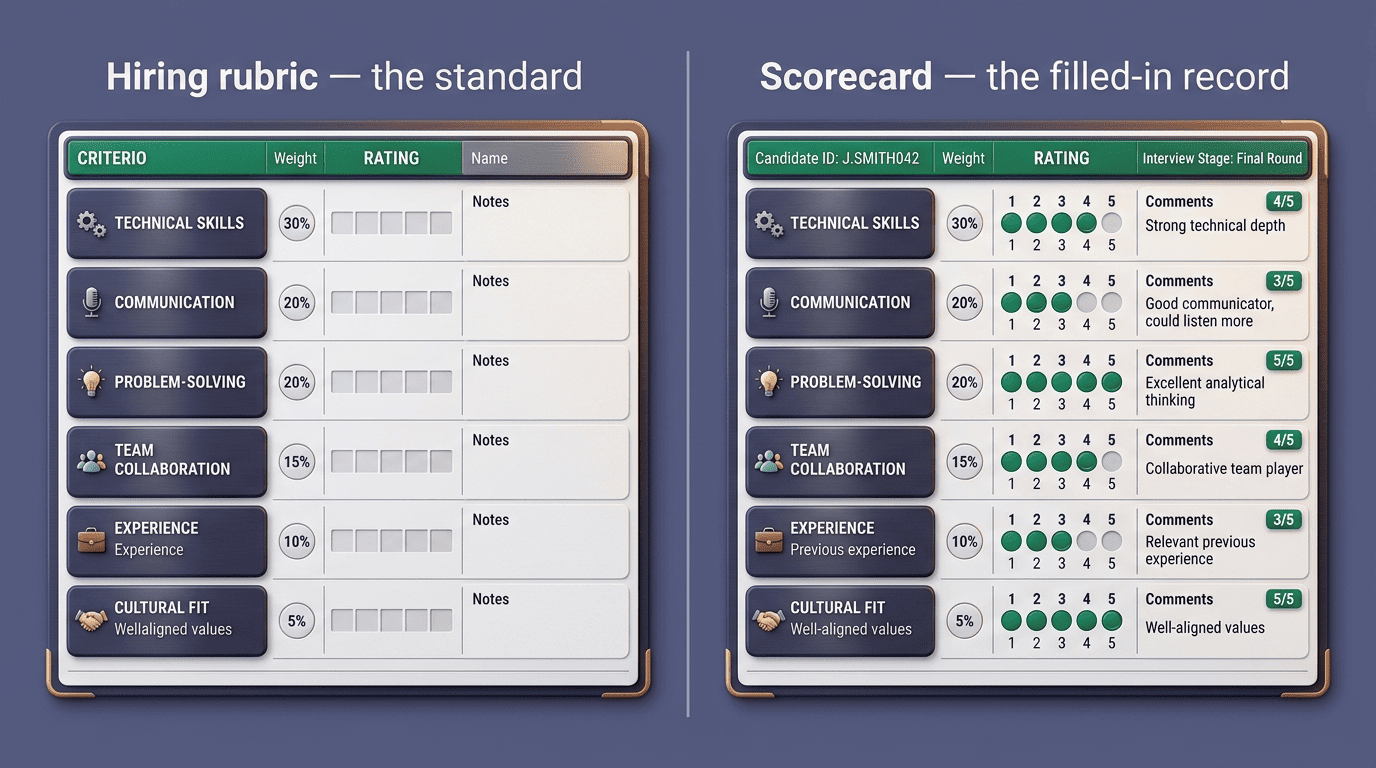
Some vendors describe the rubric as the earlier, upstream step in the hiring funnel — the version of the evaluation that gets locked in before a single interview happens, so scoring can’t drift as more candidates come through.
Building weighted criteria
Split the factors that matter into three tiers, then assign a weight and a score threshold to each so the final number reflects what actually predicts success in the role rather than what’s easiest to measure.
| Tier | Purpose | Typical weight |
|---|---|---|
| Must-have | Disqualifying if missing (certification, years of experience, legal eligibility) | 40-50% |
| Nice-to-have | Adds to the score but isn’t disqualifying | 30-40% |
| Bonus | Small edge for standout candidates | 10-20% |
Align the rubric to the job before the first interview happens — the same rubric should power your AI recruiter interview questions so the questions asked and the criteria scored stay in sync instead of drifting apart over a hiring cycle.
Consistency and Speed at Scale
Structured, rubric-based scoring applies identical reasoning whether a team is reviewing 10 candidates or 1,000. That’s a different guarantee than “the AI is fast” — speed without consistency just means bad decisions happen faster.
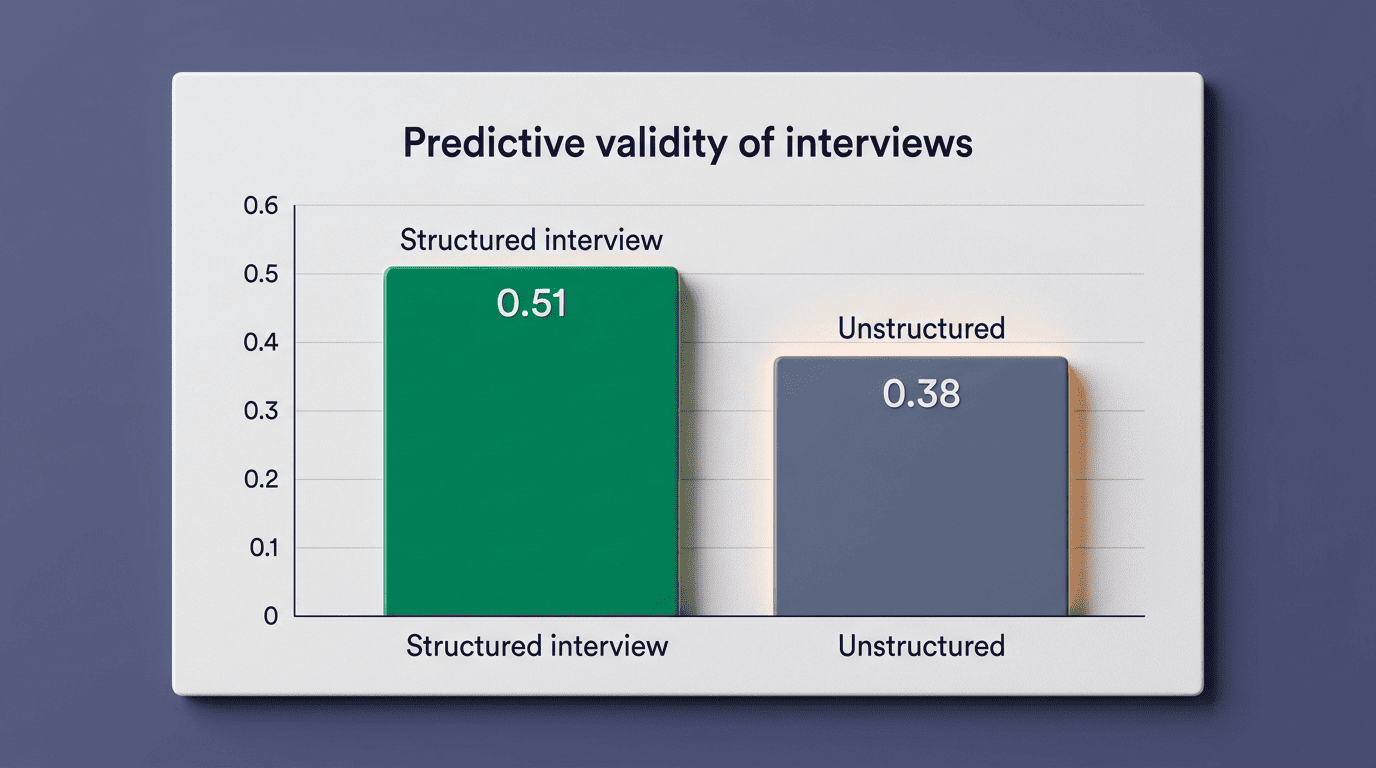
The 500th applicant in a high-volume role gets the same evaluation logic as the first, which matters because two human recruiters can reach completely different conclusions on the exact same candidate. Research on structured interviews backs this up: a well-known meta-analysis by Frank Schmidt and John Hunter put the operational validity of structured interviews at .51, versus .38 for unstructured interviews — a meaningful jump in how well the interview actually predicts job performance — and separate industry data links structured, rubric-based scoring to materially higher hiring precision than gut-feel review.
That consistency has real financial weight behind it. Quality of hire has been ranked the top talent-acquisition priority in LinkedIn’s 2024 talent trends research, and a bad hire can cost up to roughly 30% of that employee’s first-year salary — a figure widely cited in HR research and commonly attributed to the U.S. Department of Labor. Vendor efficiency numbers like “90% less manual screening” or “3x faster shortlist” should be treated as directional marketing claims rather than guaranteed outcomes for every team.
Bias, Fairness, and EEOC Compliance
Standardizing how candidates get evaluated is one of the strongest arguments for using an AI recruiter — and also where the legal risk concentrates if it’s done carelessly.
Where AI helps — and where it doesn’t
Standardized scoring reduces some of the noise and unconscious bias that comes from inconsistent human review, but an AI model can also learn and reproduce bias baked into the historical hiring data it was trained on. SHRM’s research on structured interviewing notes that unstructured interviews consistently show more inconsistent, biased judgments than structured ones — but as one hiring platform puts it bluntly, no technology can eliminate bias entirely, which is exactly why the human review step in the workflow isn’t optional.
The compliance guardrail (EEOC)
Federal guidance is unambiguous about where responsibility sits once a scoring tool enters the hiring process:
An employer can be held responsible under Title VII for selection procedures that use an algorithmic decision-making tool if the procedure discriminates on a basis prohibited by Title VII, even if the tool is designed or administered by another entity, such as a software vendor.— U.S. Equal Employment Opportunity Commission, May 2023 technical assistance guidance (archived; removed from eeoc.gov in 2025)
Under that EEOC guidance, employers remain responsible for adverse impact under Title VII regardless of who built the scoring tool. The four-fifths (80%) rule is the standard rule of thumb for flagging adverse impact — if a protected group is selected at less than 80% of the rate of the highest-selected group, that ratio signals a problem worth investigating — but passing the four-fifths test does not by itself prove a tool is bias-free.
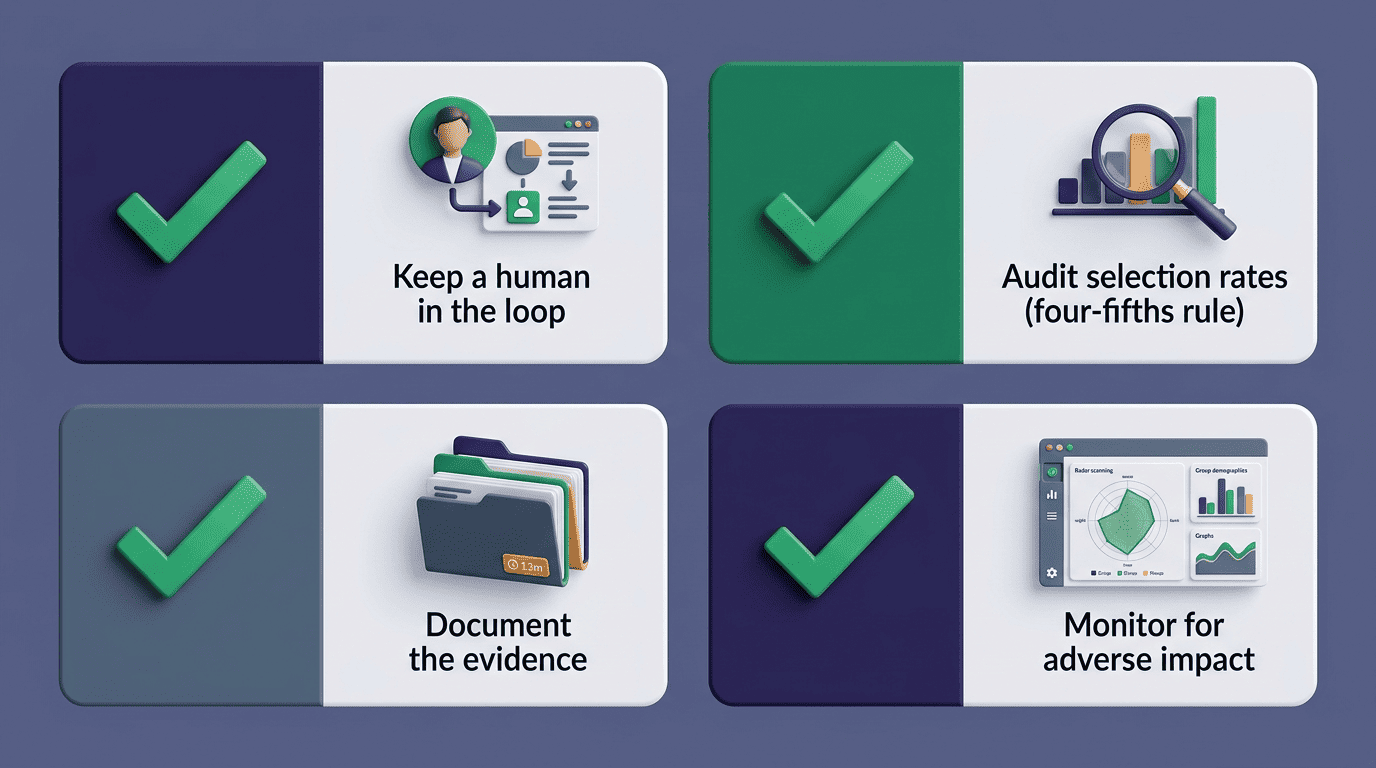
A short compliance checklist worth running on any AI-scored hiring process:
- Audit selection rates by protected group on a regular cadence, not just at launch
- Keep the scorecard’s documented evidence on file for every candidate, not only the ones who advance
- Route flagged or borderline scores to a human reviewer before any rejection goes out
- Confirm the vendor’s competency taxonomy (many map to O*NET occupational competencies) reflects the actual job, not a generic template
The rule to work by, stated plainly: AI assists; a human makes the final hiring decision and checks for bias/EEOC.
Putting It Together: An Evaluation Workflow
None of the scoring mechanics matter if they don’t fit into a workflow a recruiting team can actually run every week.
A repeatable 5-step loop
- Define the rubric — lock in the weighted competencies before the first interview.
- Let the AI screen and score every applicant against that rubric.
- Review the ranked scorecards, reading the evidence behind each score, not just the number.
- Interview the shortlist using the same criteria the scorecard was built on.
- A human makes the final call, logs the decision, and the AI recruiter syncs the result back to the ATS.
Keep a paper trail. Export scorecards as PDFs and store the underlying evidence and rationale alongside the decision — this file doubles as the onboarding brief for the hiring manager and as the compliance record if a rejected candidate ever challenges the outcome. Most AI recruiter platforms sync directly with an ATS like Greenhouse, Lever, or Workable so this record lives in one system instead of scattered across spreadsheets and inboxes.