
AI Recruiter vs Human Recruiter: Where Each Wins in 2026
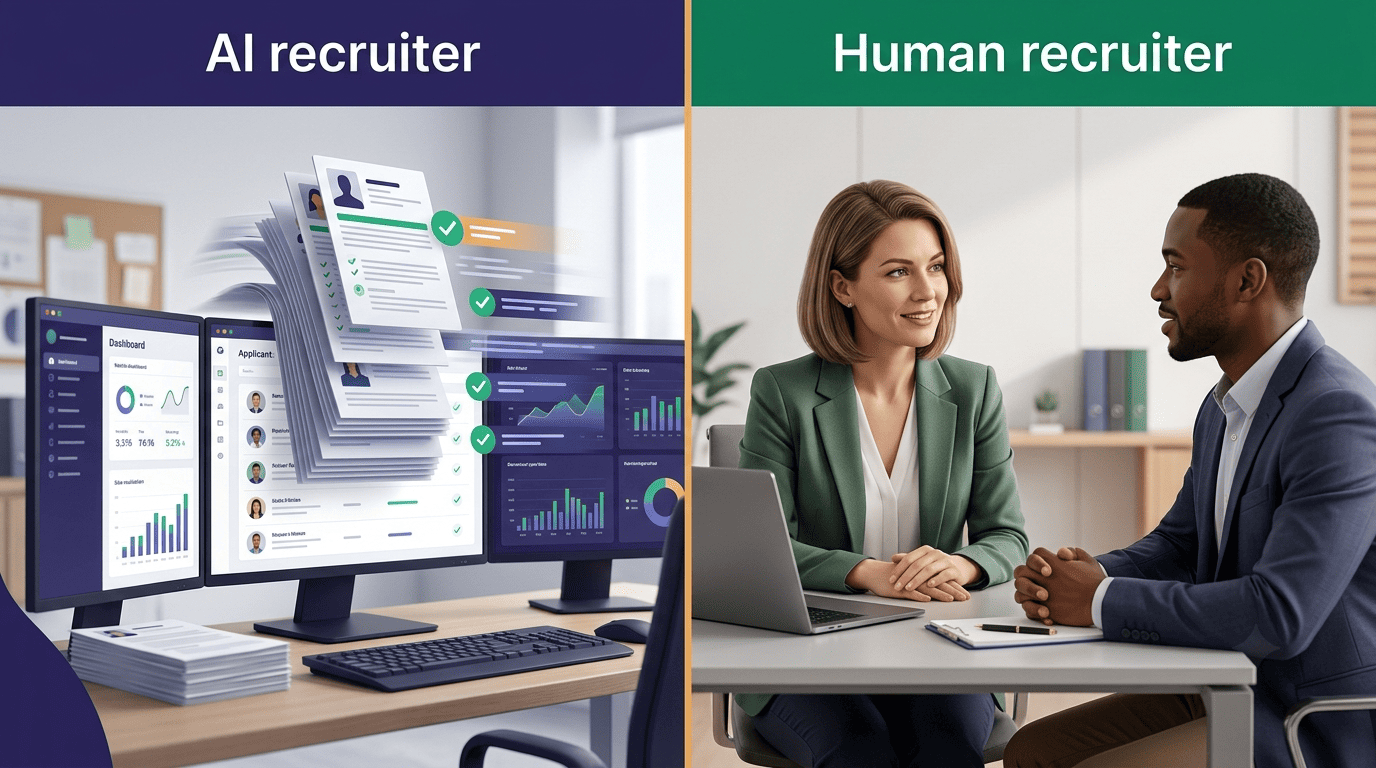
The debate isn’t really “AI recruiter vs human recruiter” — it’s about which parts of hiring each one does best. An AI recruiter handles the high-volume, repeatable work of sourcing and screening; a human recruiter owns judgment, relationships, and the final call.

The rule most teams settle on is simple: AI measures, humans decide. AI assists; a human makes the final hiring decision and checks for bias/EEOC.
What an AI Recruiter and a Human Recruiter Actually Do
An AI recruiting assistant and a human recruiter aren’t competing for the same job — they sit at different points in the same hiring funnel, and mixing them up is where most “which is better” debates go wrong.
The AI recruiter’s job
An AI recruiter is software that automates sourcing, resume screening, candidate ranking, interview scheduling, and first-round outreach inside or around an applicant tracking system (ATS). Adoption is no longer niche: roughly 70-80% of organizations now use at least one AI tool somewhere in HR, and most that do report measurable benefits from it. McKinsey’s State of AI research found that 88% of organizations report regular AI use in at least one business function.
The human recruiter’s job
A human recruiter owns the relationship layer: intake calls with hiring managers, judgment on ambiguous or unconventional profiles, negotiation, and closing the offer. AI plays little to no role in offer negotiation — compensation, relocation, and start-date flexibility are still worked out person to person. The two aren’t rivals; they’re different layers of the same funnel.
| Task | Typically owned by |
|---|---|
| Sourcing and initial screening | AI recruiter |
| Resume ranking against the job description | AI recruiter |
| Interview scheduling | AI recruiter |
| Hiring-manager intake and calibration | Human recruiter |
| Interviewing for nuance and team fit | Human recruiter |
| Offer negotiation and closing | Human recruiter |
| Final hiring decision | Human recruiter |
Adoption numbers back up the split:
- Roughly 70-80% of organizations use at least one AI tool somewhere in HR, per multiple 2025-2026 industry surveys.
- 88% of organizations report regular AI use in at least one business function (McKinsey, State of AI 2025).
- Most organizations already using AI in HR report measurable benefits from it, though the exact share varies by survey.
Where the AI Recruiter Wins
It parses applications at a scale no human team can match. An AI recruiter parses hundreds of applications in seconds and thousands of resumes in minutes; a recruiter reading 200 resumes by hand takes days to get through the stack. Scheduling that normally takes 3–5 emails and days of back-and-forth becomes near-instant once an AI recruiting assistant owns the calendar handshake.
It grades every applicant with the same rigor. An AI recruiter scores the thousandth candidate exactly as carefully as the first — no fatigue, no off day, no “bad Tuesday” affecting who gets a callback. SHRM survey data shows 89% of HR professionals say AI saves time, and 36% report measurable cost reductions from using it.
It’s cheaper and faster, according to the vendors selling it. Vendor case studies and industry benchmarks report time-to-hire dropping by roughly 40-70% and cost-per-hire falling by roughly 30-50% when AI screening replaces manual review. Those ranges come from AI recruiting software vendors and industry reports, not independent controlled research, so treat them as directional rather than guaranteed — but they line up with the broader efficiency data from SHRM and McKinsey.
Where the Human Recruiter Wins
Speed and consistency are AI recruiter strengths; judgment and trust are not. That’s where the human side of the funnel earns its keep.
Judgment and unconventional talent
A human recruiter spots candidates with transferable skills or non-linear career paths that a keyword-driven algorithm filters out before a person ever sees the resume. Reading “the person behind the resume” — team fit, manager fit, real motivation for the move — is still a human skill, not a scoring function.
Relationships, negotiation, and closing
Only a human recruiter can nuance an offer when the deciding factor is a flexible schedule, relocation support, or equity rather than base salary. Relationship-building through the process measurably raises offer acceptance and retention, and persuading a passive candidate — someone not actively job hunting — to take a call in the first place is still human work.
Work that stays human even in an AI-heavy hiring process:
- Reading transferable skills on a non-traditional resume.
- Calibrating with a hiring manager on what “culture fit” actually means for the team.
- Negotiating comp, relocation, and start-date flexibility.
- Persuading a passive candidate to engage in the first place.
- Owning the final hiring decision and its compliance sign-off.
Cost and Time: A Practical Comparison
The numbers
Recruiting agency fees typically run 15–25% of a role’s first-year salary, and a bad hire is commonly estimated to cost 1–2x that employee’s annual salary once training, severance, and lost productivity are counted (some sources put executive bad hires even higher, at 2–3x). AI recruiting software compresses screening from days to minutes, which is where most of the cost savings originate. In at least one publicized case, front-loading AI screening sharply cut the number of human interviews needed per offer before candidates ever reached a recruiter’s calendar. Deloitte’s 2026 Global Human Capital Trends research found that organizations taking a human-centric approach to AI — rather than a purely tech-focused approach — are about 1.6x more likely to exceed their expected returns on AI investment; that finding is about AI adoption broadly, not hiring specifically, but it’s consistent with what hybrid recruiting teams report.
Where the cost actually shows up:
- Agency or contingency recruiter fees: 15–25% of first-year salary.
- Cost of a bad hire: 1–2x annual salary once ramp-up and turnover are counted.
- AI screening time: minutes instead of days per requisition.
- Human interviews per offer: can drop sharply when AI pre-screens the funnel.
Comparison table
| Dimension | AI recruiter | Human recruiter | Winner |
|---|---|---|---|
| Speed at scale | Screens thousands of resumes in minutes | Reviews dozens per day | AI recruiter |
| Consistency | Same scoring logic every time | Varies with fatigue, mood, bias | AI recruiter |
| Cost per hire | Lower marginal cost per applicant | Higher, driven by recruiter hours | AI recruiter |
| Sourcing scale | Searches thousands of profiles instantly | Limited by hours in the day | AI recruiter |
| Judgment on nuance | Weak on unconventional profiles | Reads context, transferable skills | Human recruiter |
| Empathy and closing | Cannot negotiate comp or relocation | Builds trust, closes offers | Human recruiter |
| Bias control | Can amplify or reduce bias depending on training data | Inconsistent, but correctable with training | Depends on oversight |
| Compliance ownership | Flags risk, doesn’t own liability | Accountable for EEOC/EU AI Act compliance | Human recruiter |
Is the AI Recruiter Biased? Fairness and Compliance
Both directions of the bias story
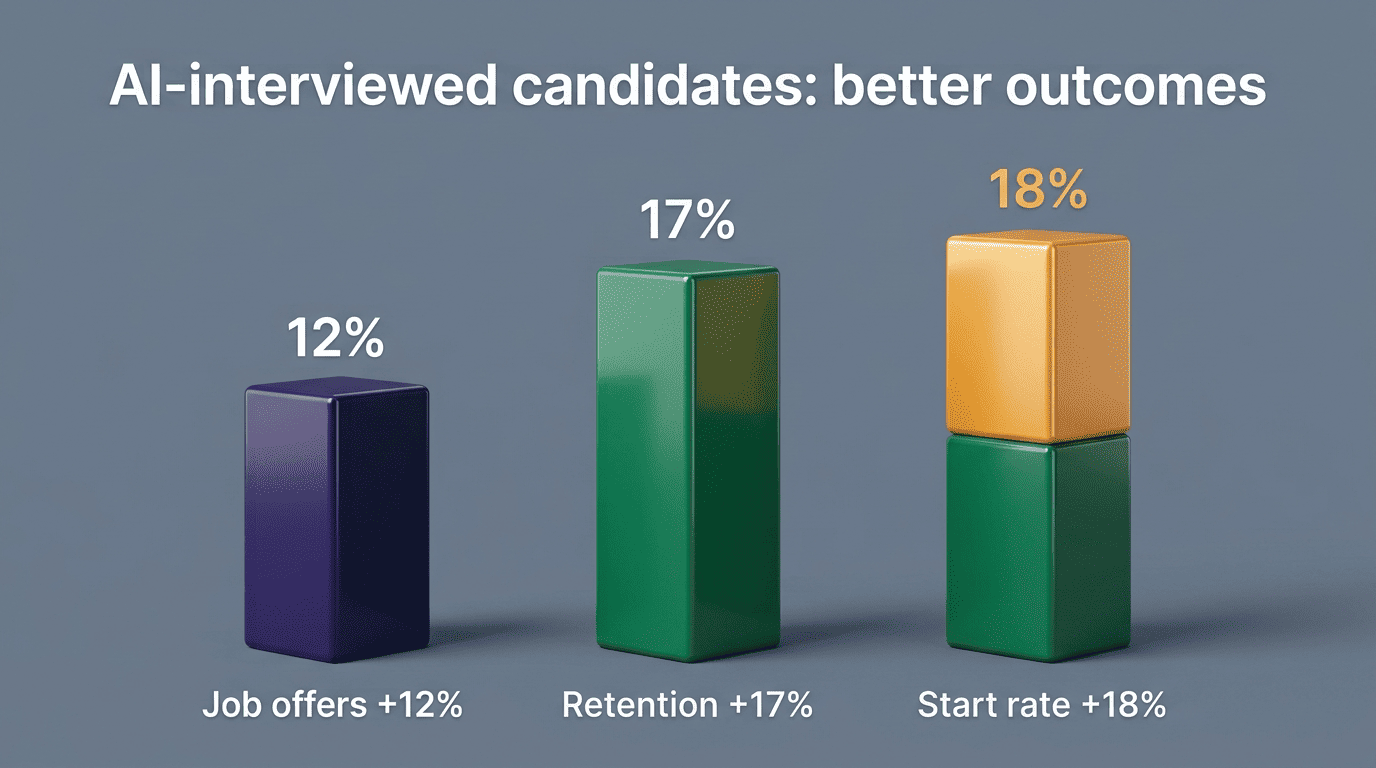
Structured AI scoring can actually cut down on inconsistent human bias. A Chicago Booth field experiment with roughly 70,000 customer-service applicants found that candidates interviewed by a voice-AI interviewer received 12% more offers, had an 18% higher start rate, and were 17% more likely to stay 30 days — and reported gender discrimination was roughly halved compared with human-only interviews. About 60% of the recruiters surveyed had predicted the AI interviews would produce lower-quality hires; they were wrong.
But the same technology can cut the other way. An AI recruiter trained on biased historical hiring data can learn and repeat that bias, and keyword overemphasis in resume screening can reject strong, keyword-poor candidates who would otherwise be a good fit. Understanding how AI recruiting bias actually enters the pipeline — and how to audit for it — matters more than picking a side in the “is AI biased” debate.
Adoption is outpacing the governance most companies have in place to check it, which is exactly the gap regulators are now targeting.
Eighty-eight percent of organizations report using AI in at least one business function.
McKinsey, The State of AI
Staying compliant
In the European Union, the EU AI Act classifies AI systems used for recruitment and candidate evaluation as high-risk, which triggers transparency and documentation requirements. In the United States, the EEOC’s guidance on algorithmic decision-making tools applies existing civil rights law to AI-assisted hiring. AI assists; a human makes the final hiring decision and checks for bias/EEOC.
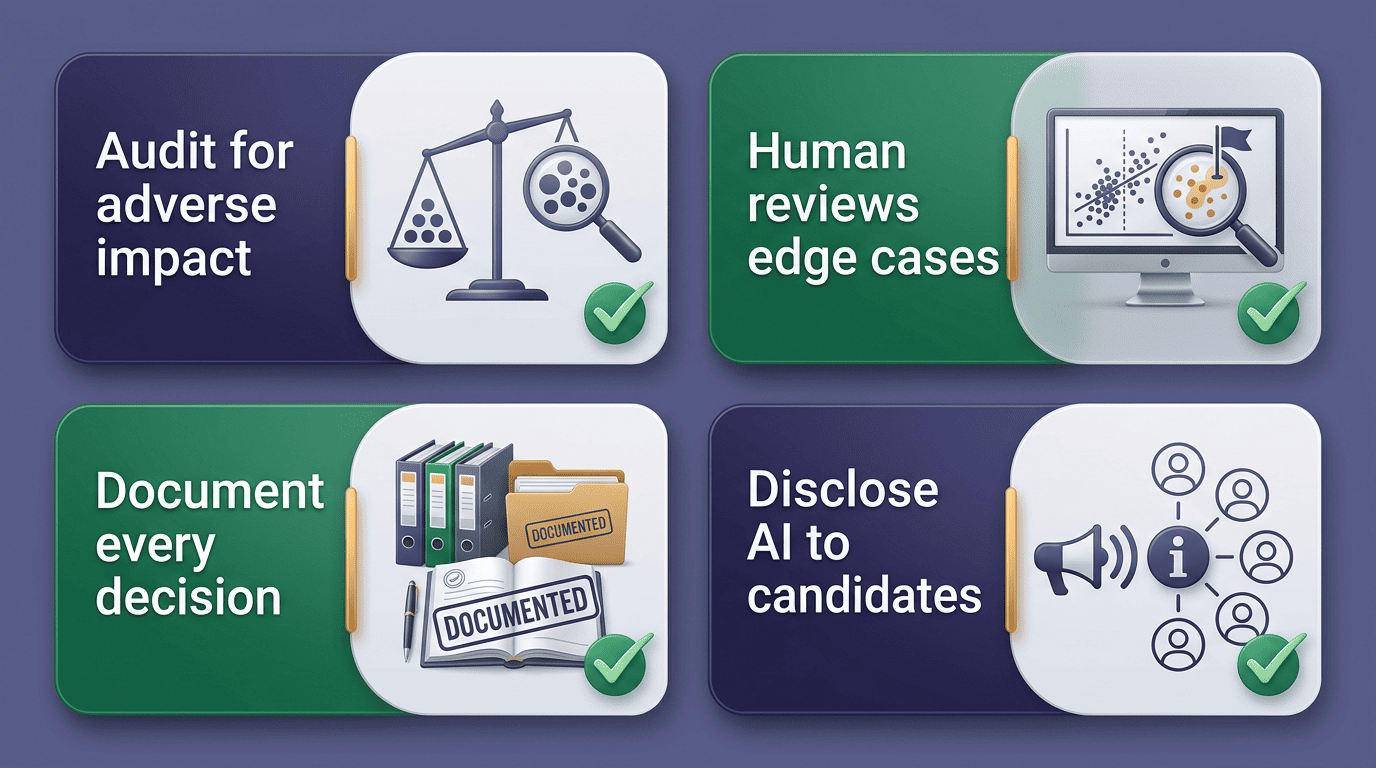
Practical steps for staying compliant:
- Audit AI recruiter outputs regularly for adverse impact across protected groups.
- Keep a human reviewing edge cases and borderline rejections, not just top-ranked candidates.
- Document every AI-assisted decision point in case of an audit or complaint.
- Disclose to candidates when AI is used in screening or interviewing, per EU AI Act and emerging US state rules.
Can an AI Recruiter Replace a Human Recruiter?
No — and the framing itself is the wrong question. Every credible source on this topic lands on the same conclusion: it’s AI with humans, not AI versus humans. An AI recruiter can rank a thousand candidates overnight, but blindly trusting that ranking without human review means a shortlist gets passed along unchecked, and strong, unconventional candidates quietly fall out of the funnel before anyone meets them.
The Hybrid Recruiting Model (What Actually Works)
How to split the workflow
The hybrid model draws a clear line: AI owns the top of the funnel, humans own everything that requires judgment. In practice, that means AI resume screening handles sourcing, first-pass ranking, scheduling, and 24/7 candidate Q&A, while recruiters handle calibration with hiring managers, edge-case review, interviews for nuance, negotiation, and the final decision.
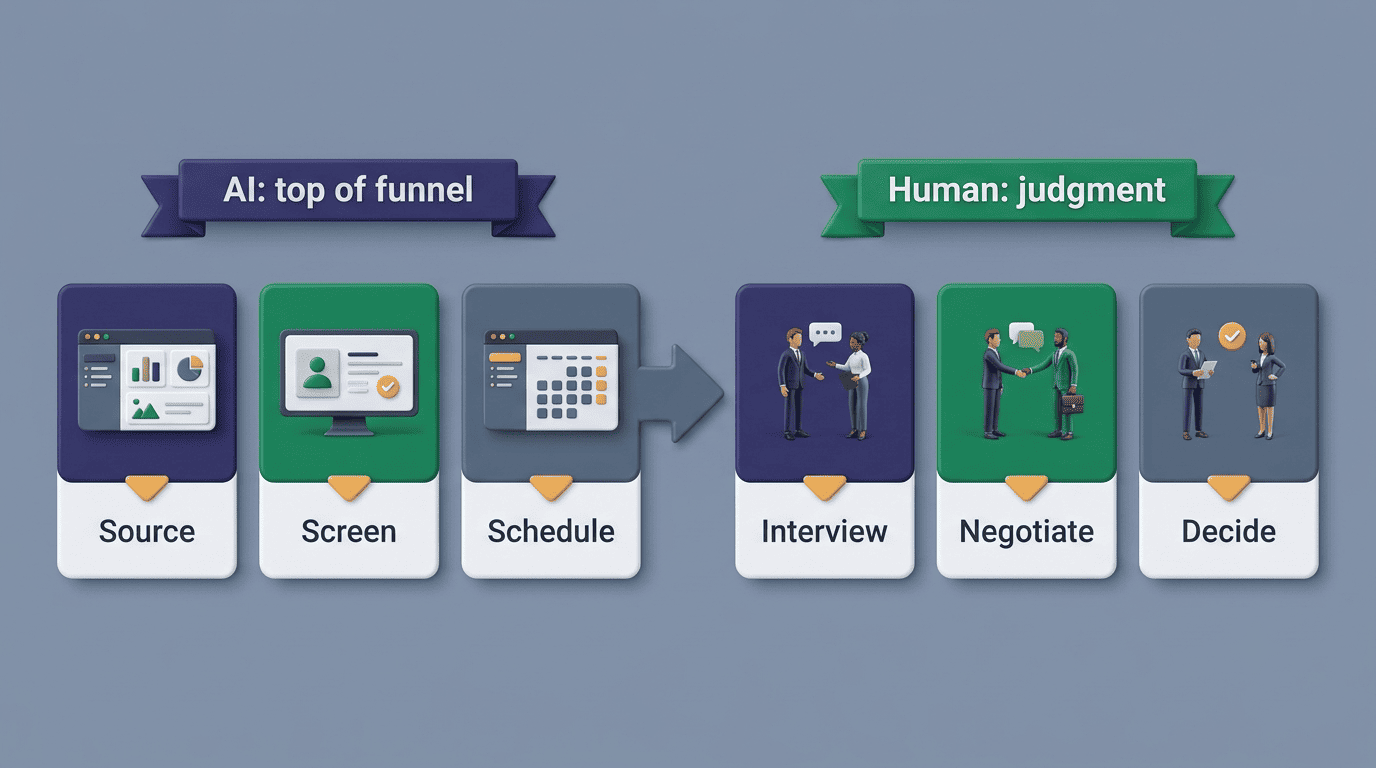
A simple rollout looks like this:
- Map the current hiring funnel and mark which stages are repeatable versus judgment-based.
- Assign an AI recruiter to the repeatable stages: sourcing, screening, scheduling.
- Keep every judgment-based stage — intake, finalist interviews, negotiation — with a human recruiter.
- Run a pilot for 2–4 weeks on a single role family before rolling out further.
- Measure time-to-fill, cost-per-hire, offer-acceptance rate, and early attrition before and after.
- Adjust which stages AI handles based on what the pilot data shows.
The one-line rule
AI measures, humans decide. That single sentence is the entire hybrid model — everything else is implementation detail.