
AI Recruiter Interview Questions: How to Turn a Job Description Into a Structured, Fair Interview
An AI recruiter can turn a job description into a full set of interview questions in under a minute — a task that takes an experienced recruiter 20-30 minutes to draft by hand. But the real value isn’t speed; it’s structure, since decades of research collected on Wikipedia’s structured interview entry show that asking every candidate the same well-chosen questions and scoring them on the same rubric is one of the strongest predictors of job performance available to hiring teams.

This guide walks through the exact question types an AI recruiting assistant produces — structured, behavioral (STAR), situational, and technical — with ready-to-use examples, plus how to build a candidate scorecard. One rule never changes: a human reviews every question and makes the final hiring call.
Can an AI Recruiter Actually Write Good Interview Questions?
Recruiters who try an AI recruiter for the first time usually ask the same thing: will the questions actually be useful, or just generic filler? The short answer is that quality depends entirely on what the AI is given to work with, and on how the output is used afterward.
What the AI is really doing
An AI recruiter reads the job description, infers the skills and behaviors the role requires, and drafts questions anchored to that actual work rather than a generic template. Adoption is now mainstream: industry surveys commonly put AI use somewhere in the recruiting process at the majority of companies, with figures cited around 87% in some 2026 reports — the exact number varies by survey and by how loosely “AI use” is defined, from formal hiring-platform adoption down to individual recruiters using a chatbot. Generation itself takes under 60 seconds versus the 20-30 minutes a recruiter typically spends drafting a question set by hand, and a single run usually returns 4-9 role-specific questions ready for review.
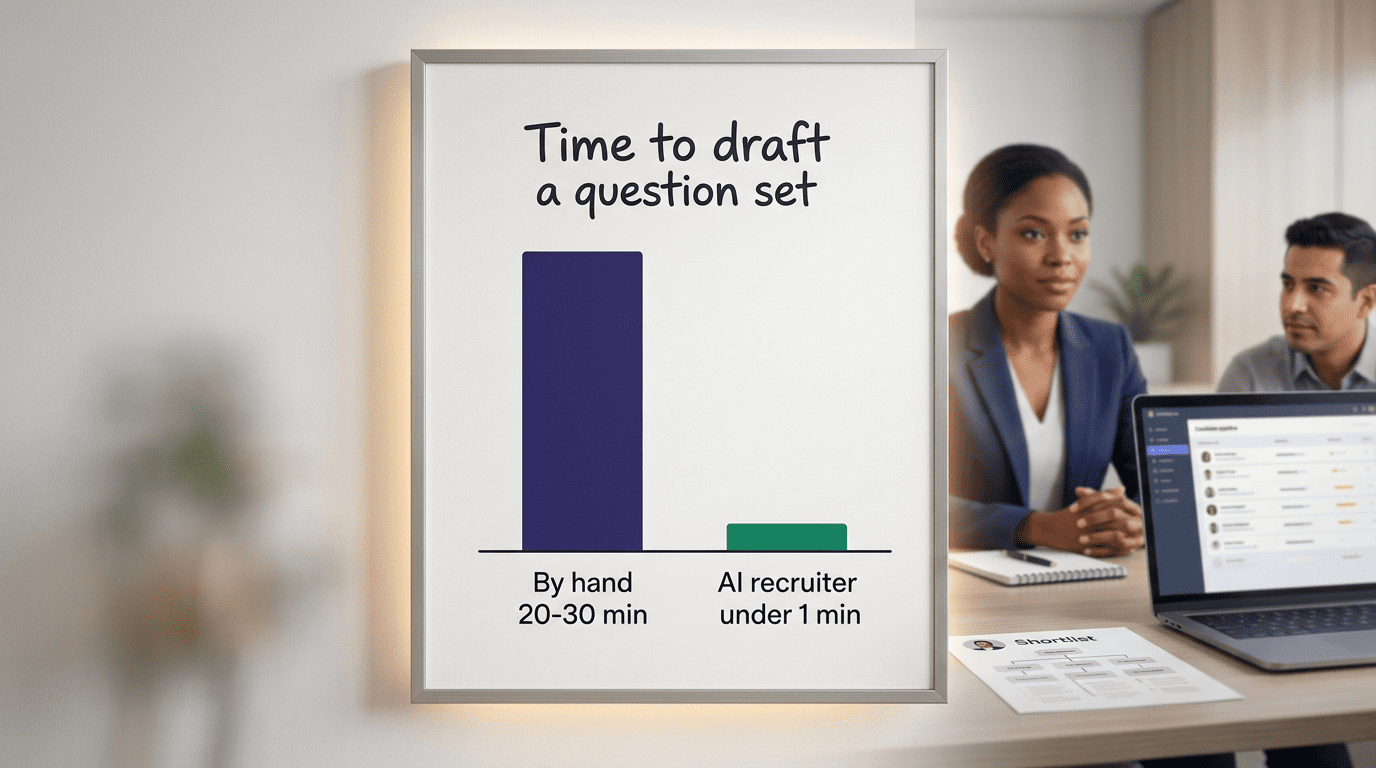
That speed is what makes the tool practical for high-volume hiring — a team filling ten roles in a quarter can’t spend an afternoon drafting each interview guide from scratch, so an AI recruiter turns a task that used to get skipped or rushed into one that happens consistently for every open role.
Why “good” means “structured,” not “clever”
The AI’s job is not to invent a clever gotcha question. It’s to enforce structure — the same questions, in the same order, judged against the same scoring guide for every candidate. That consistency is what the research behind the structured interview format is built on: identical questions and consistent scoring reduce the noise that comes from interviewer mood, memory, and personal preference, and make comparisons between candidates far more defensible.
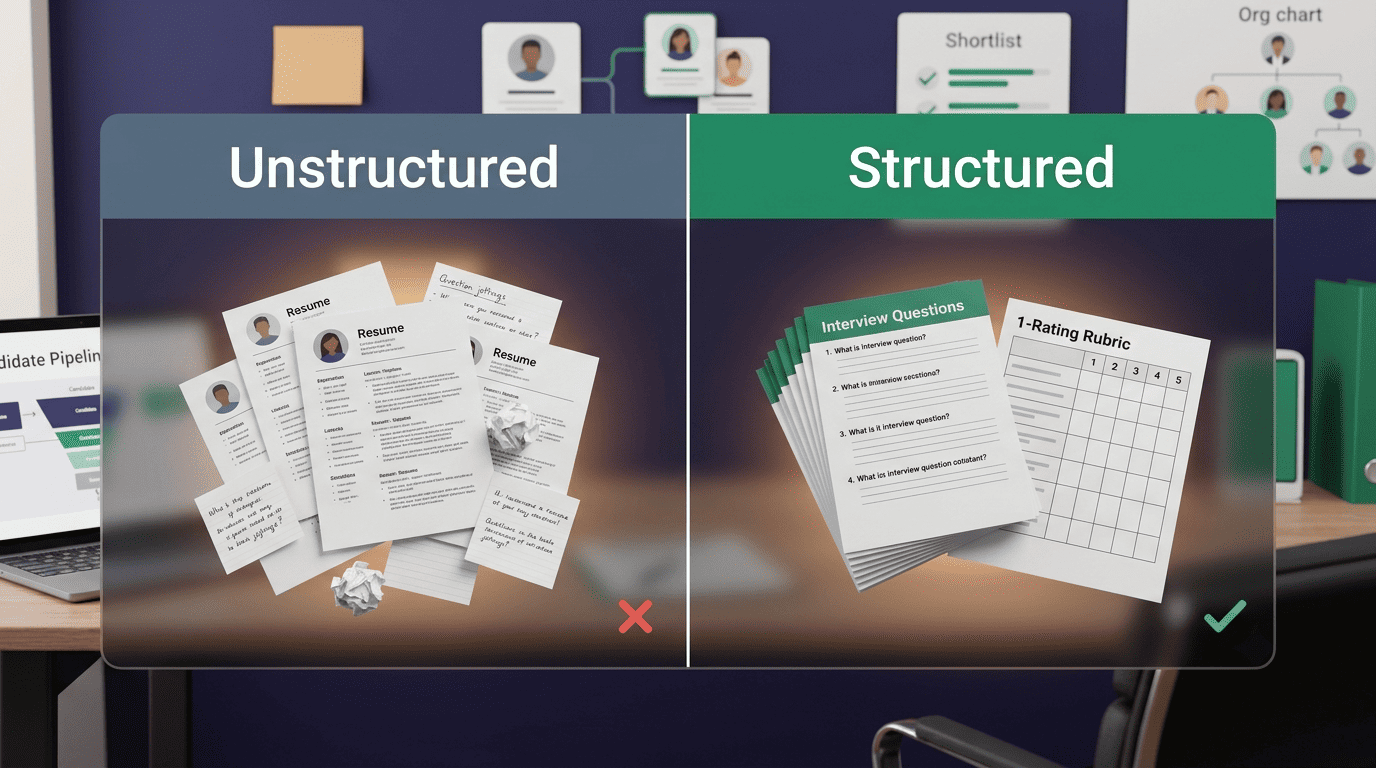
In practice, most hiring teams land somewhere on a spectrum between fully improvised chats and rigid structure. The table below shows why the structured end of that spectrum, generated and kept consistent by an AI recruiter, tends to produce better hiring outcomes.
| Interview style | Question set | Scoring | Typical use |
|---|---|---|---|
| Unstructured | Improvised per candidate | Gut feel | Casual chats, poor predictor |
| Semi-structured | Core questions + follow-ups | Loose notes | Common but inconsistent |
| Structured (AI-assisted) | Same questions, same order | Defined rubric, 1-5 scale | Recommended for hiring decisions |
From Job Description to a Structured Question Set
Turning a job posting into an actual interview guide is mostly an input problem: the AI can only anchor questions to details that are actually present in the job description it’s given.
The four inputs that shape the questions
Give the AI recruiter these four inputs and the output improves sharply:
- The full job description
- The 4-6 core competencies for the role
- The seniority level
- Any must-have skills
The more specific the job description, the more the resulting questions anchor to real work rather than generic filler — a vague JD produces vague questions, no matter how capable the underlying large language model is.
What a structured set looks like
A structured interview asks every candidate the same questions in the same order and rates each answer against a defined rubric. That consistency is what makes side-by-side comparisons fair and defensible if a hiring decision is ever challenged. A balanced AI-generated set typically looks like this:
- 2-3 behavioral questions, scored with STAR
- 1-2 situational questions, testing judgment on hypothetical scenarios
- 1-2 technical or role-specific questions, verified by a subject-matter expert
- Each question rated 1-5 against a named competency
This mix of competency-based recruitment principles — questions tied to specific, pre-defined skills rather than open-ended chat — is what separates a structured AI-generated interview guide from a list of generic questions pulled off a blog.
Behavioral Questions and the STAR Method
Behavioral questions are the backbone of most structured interviews an AI recruiter generates, precisely because they anchor to something that actually happened rather than a hypothetical.
Why behavioral beats hypothetical for past performance
Behavioral questions ask candidates to describe a specific past situation — “Tell me about a time you…” — which is harder to fake convincingly than a rehearsed pitch about what someone would theoretically do. Answers are scored with the STAR method: Situation, Task, Action, Result. SHRM’s guidance on the STAR interview method frames STAR-based answers as verifiable and evidence-based — a linear account of a situation, task, action, and outcome that’s harder to fake than a candidate’s self-assessment.

In broad strokes, that’s the same logic behind behavioral interviewing generally: it’s a widely used technique precisely because past behavior tends to predict future performance better than a candidate’s stated intentions.
Example behavioral questions an AI recruiter generates
An AI recruiting assistant typically drafts questions like these, each tagged to the competency it targets:
- “Tell me about a time you missed a deadline. What happened, and what did you change afterward?” — tests accountability
- “Describe a conflict with a coworker and how you resolved it.” — tests collaboration
- “Walk me through a project where the requirements changed midway through.” — tests adaptability
- “Give an example of a decision you made with incomplete information.” — tests judgment
The AI drafts these as a starting set; the recruiter still edits wording for role fit and removes anything that doesn’t match the actual job.
Situational and Technical Questions
Behavioral questions cover what a candidate has already done; the remaining two question types in a balanced set cover what a candidate would do next and what they can actually do technically.
Situational: “What would you do if…” Situational interview questions probe judgment against hypothetical future scenarios rather than documented past behavior — a distinction covered in Wikipedia’s entry on the situational judgement test format that underpins this question style. Examples an AI recruiter might generate include: “A top candidate is about to accept a competing offer. What do you do in the next hour?”, “You realize a live job post has a discriminatory phrase. What’s your first move?”, and “A teammate consistently misses their commitments. How do you address it?”
Technical / role-specific. The AI recruiter tailors technical questions to the job description’s hard skills rather than pulling from a generic bank. A typical example: “Write a Boolean search string for a senior data engineer with Spark and Kubernetes experience.” Recruiters should always verify technical questions with a subject-matter expert before using them — an AI recruiter can draft a plausible-sounding technical question that is subtly wrong for the actual stack a team uses, and only someone who works in that stack will catch it.
Turning Questions Into a Candidate Scorecard
A good question set is only half the job — without a shared scorecard, five interviewers will still score the same answer five different ways.
A scorecard makes the interview comparable
A candidate scorecard records ratings against each defined competency, so five different interviewers grade on the same scale instead of relying on gut feel after the fact. An AI recruiting assistant can attach a two-tier rubric to every question — a description of what a “strong” answer looks like and what an “acceptable” answer looks like — so scoring stays consistent even across interviewers who have never compared notes. For how these ratings roll up into an actual hiring decision, see our guide on AI recruiter candidate evaluation.
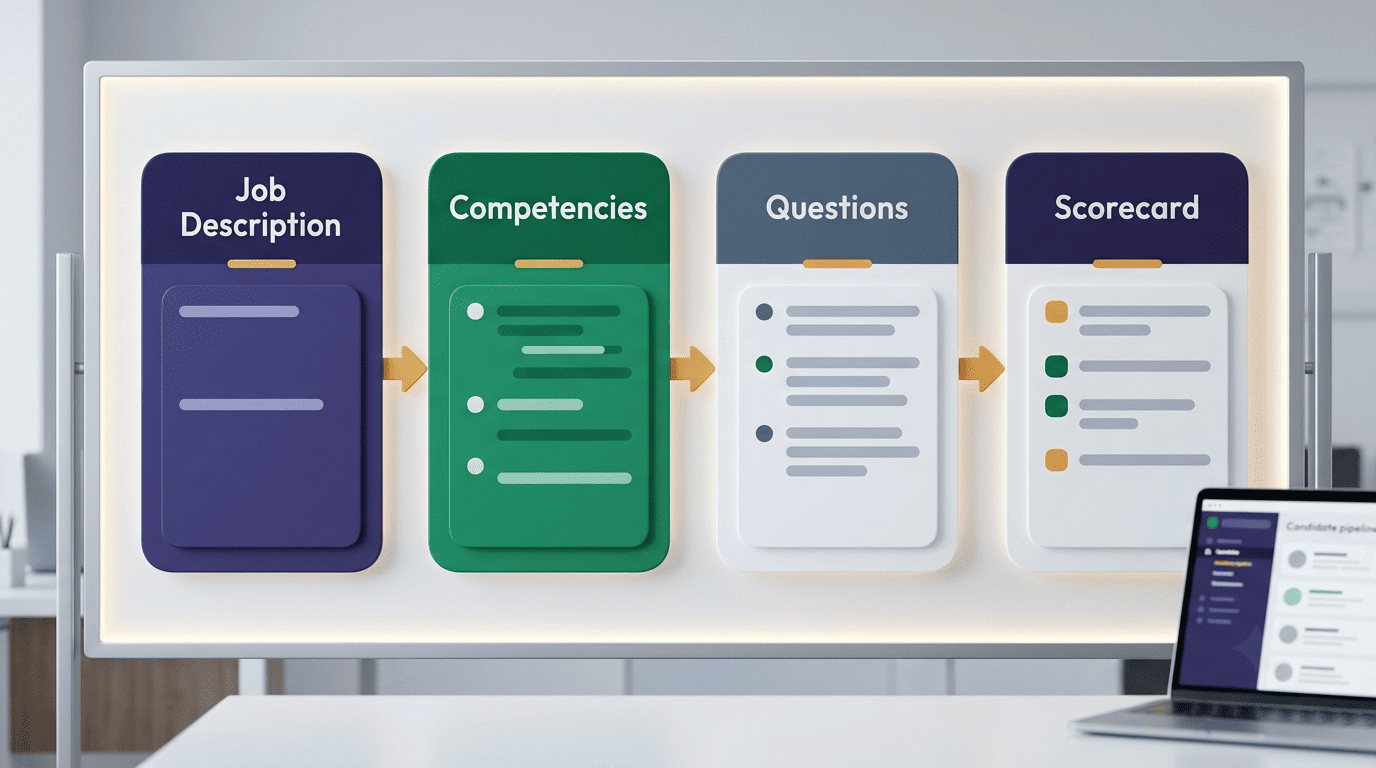
Without a shared scorecard, hiring debriefs tend to turn into a debate about vague impressions — “I liked them” versus “something felt off” — instead of a comparison of evidence. A rubric filled in during the interview, question by question, keeps the debrief anchored to specifics.
Keep it tied to the role
Every scorecard row should map back to a competency in the job description — the same job description the AI used to write the questions in the first place. If the JD and the scorecard drift apart, the interview stops measuring what the role actually needs. For building that job description in the first place, see how an AI recruiter drafts job descriptions.
A quick sanity check works well here: pick any row on the scorecard and ask whether a hiring manager could point to the exact line in the job description it maps to. If they can’t, either the scorecard has drifted or the job description was too vague to begin with.
| Competency | Question type | Rating (1-5) | Notes |
|---|---|---|---|
| Accountability | Behavioral | — | Missed-deadline example |
| Adaptability | Behavioral | — | Changing-requirements example |
| Judgment | Situational | — | Hypothetical scenario |
| Technical skill | Technical | — | Verified by SME |
Building a Structured Interview Guide: A Step-by-Step Checklist
Pulling the pieces above together into a repeatable process looks like this:
- Start from a finished, specific job description — vague inputs produce vague questions.
- Identify 4-6 core competencies the role actually requires.
- Generate a draft question set with the AI recruiter (structured mix: behavioral, situational, technical).
- Have a human reviewer read every question and remove anything off-target or risky.
- Strip out any question that touches a protected characteristic.
- Attach a scoring rubric to each question before the first interview happens.
- Run the same question set and rubric across every candidate for the role.
The Non-Negotiable: Human Review and Fair, Legal Questions
Everything above assumes one condition that never changes: an AI recruiter drafts and scores, but it does not decide who gets hired, and it must never be allowed to ask something the law prohibits.
A human reviews every question
An AI recruiter drafts questions; it does not make the hiring decision. Generative AI can also produce flawed, off-base, or overly aggressive questions, so a recruiter must read, edit, and approve each one before it ever reaches a candidate. Treat every AI-drafted question as a first draft, not a final product.
This review step takes a few minutes per job description and it is the single most important part of the workflow. Skipping it defeats the purpose of using structured, defensible interviews in the first place — a set of questions is only fair if a qualified person has actually checked it.
No questions about protected characteristics
Under EEOC guidance on prohibited employment practices and Title VII of the Civil Rights Act, interviewers may not use questions to probe protected characteristics, including:
- Race, color, or national origin
- Religion
- Sex (including pregnancy, sexual orientation, and gender identity)
- Age (40 and over)
- Disability or genetic information
Marital status isn’t a protected category under federal Title VII, but it is protected under many state and local laws, and the EEOC treats questions about marital or parental status as evidence of discriminatory intent when they’re used to screen out women — so it belongs on the “don’t ask” list either way.
An AI recruiter should never surface such questions in the first place, and reviewers must strike any that drift toward them, including indirect ones (asking about resume “gaps” in a way that fishes for pregnancy or disability status, for example). Regulators are increasingly auditing hiring AI directly — New York City’s Local Law 144 requires an annual bias audit for automated employment decision tools, and similar obligations are expanding elsewhere.
This article is general guidance, not legal advice. AI recruiting software speeds up drafting and helps keep scoring consistent, but a qualified human must review every question before it’s used, avoid biased or discriminatory topics, and make the final hiring decision. Consult your legal or compliance team on jurisdiction-specific rules before rolling out AI-assisted interviewing at scale.